Okutama
ExploreJapanDaily Editorial Team · Last updated: August 28, 2026 · Facts verified: August 28, 2026
- Area
- Nishitama District
- Best For
- Hiking, Nature, Day Trips
- Nearby
- Mount Mitake
Visiting Okutama
Okutama is Tokyo's mountainous far-western edge, a town so large and so rural that it barely resembles the same Tokyo Metropolis as Shibuya or Shinjuku, despite falling under the same administrative umbrella.
At 225.53 square kilometers, Okutama is the largest municipality in Tokyo by land area, yet its population sits under 5,000, a fraction of what a single busy Tokyo neighborhood holds. Mount Kumotori, Tokyo's highest point at 2,017 meters, rises within its borders, along with the capital's westernmost and northernmost points. It is a genuinely strange fact of geography: the same Tokyo that includes Shinjuku Station's crowds also includes a town this remote.
It helps to settle one point of geography early, since it comes up often in travel planning. Okutama Town sits in Nishitama District, and its headline attractions, Lake Okutama, the Nippara Limestone Cave, and the Okutama Mukashi Michi trail, are all genuinely within the town itself. Mount Mitake, a well-known mountain and shrine frequently grouped together with Okutama in travel guides, actually sits across the municipal line in neighboring Ome City. The two areas share the same JR Ome Line and a similar mountain character, but they are separate places with separate things to see, and this page focuses on Okutama Town itself.
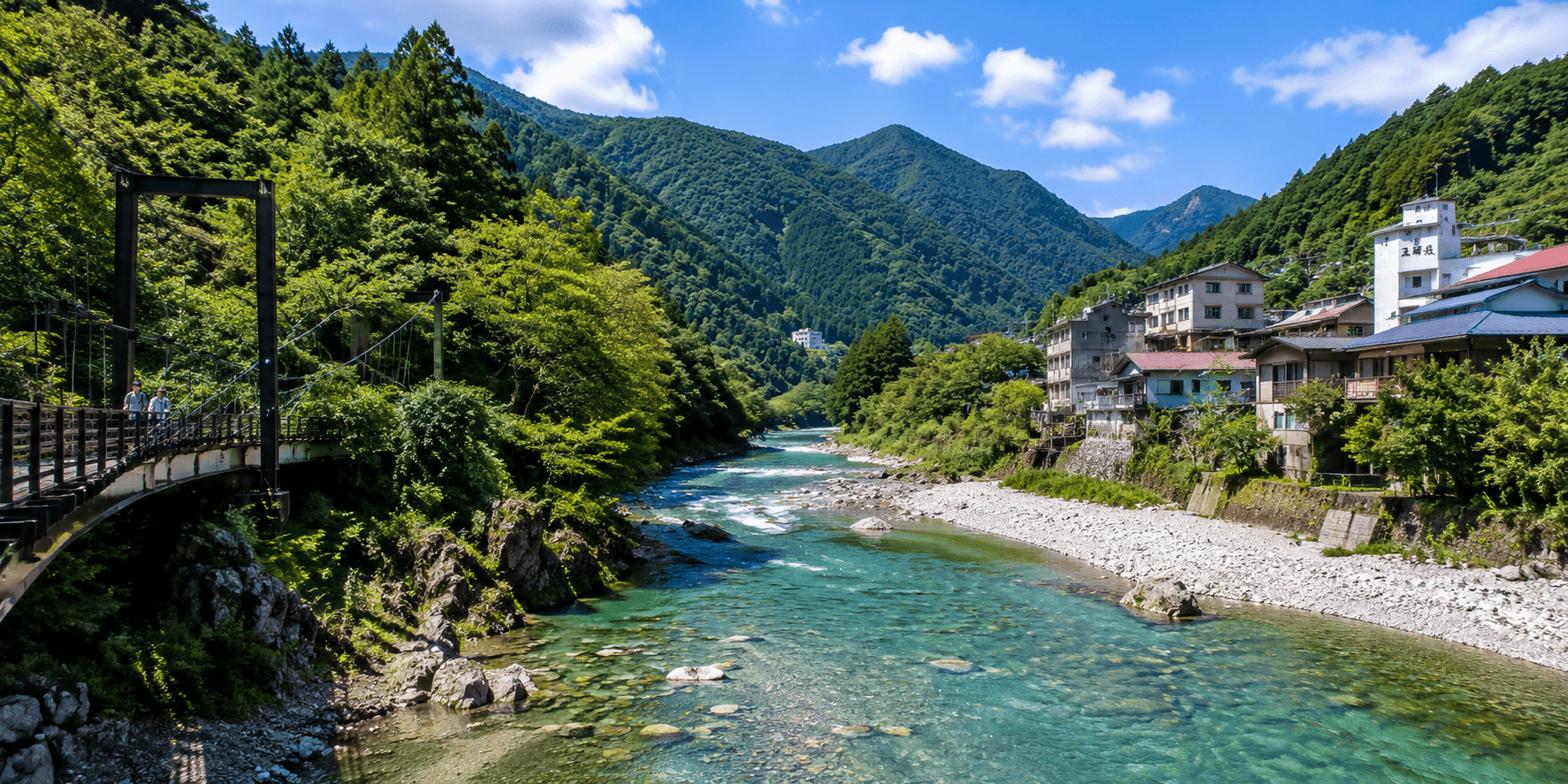
The area's shape is defined largely by water. The Tama River runs through the region, and its damming at Ogouchi created Lake Okutama, an artificial reservoir that supplies part of Tokyo's drinking water and submerged several villages in the process, a history still marked today by Ogouchi Shrine on the lake's shore.
What actually draws visitors is a genuine spread of outdoor experiences rather than one single landmark: a lake crossed by a floating bridge, one of the Kanto region's largest limestone caves, a long-distance walking trail that passes suspension bridges and old stone shrines, river valleys good for a shorter walk, and hot spring baths to end the day.
Unlike a compact Tokyo neighborhood, Okutama's attractions are spread across a genuinely large area, connected by a single train line and infrequent local buses rather than a walkable grid of streets. This is real geography, not just a planning inconvenience, and it shapes how a visit here should be structured.
The trade-off for that spread-out geography is real seasonal variety and real quiet. Okutama sees cherry blossoms in spring, river and cave activity through summer, some of the best autumn foliage anywhere accessible from central Tokyo, and a colder, calmer winter, with crowd levels that never approach the scale of central Tokyo's own attractions even at their busiest.
Reaching Okutama takes longer than almost any other Tokyo attraction on this site, roughly two hours one-way by train from Shinjuku. That longer journey is exactly why the area rewards travelers willing to make it: a genuine mountain escape that never requires leaving the city limits at all.
Things to Do at Okutama
How to Get to Okutama
Okutama sits at the far western edge of the Tokyo Metropolis, in Nishitama District, and its attractions are spread across a genuinely large area rather than clustered around one station.
Because of that spread, getting there and getting around once you arrive are two separate questions, both worth planning for before setting out.
- •Nearest station: Okutama Station, JR Ome Line
- •IC cards (Suica, Pasmo, or ICOCA) are accepted on trains, subways, and buses throughout Japan. Tap in and out at every gate.
- •Avoid traveling during rush hour on weekdays: 7am to 9am and 5pm to 8pm. Trains are significantly more crowded.
- •Google Maps provides accurate real-time transit directions in Tokyo. Download offline maps before you arrive.
For IC cards, tickets, and full transit basics for Tokyo, see the complete transportation guide.
See the Getting Around Tokyo guide →Map
Best Time to Visit Okutama
Best time to visit Okutama: Spring for cherry blossoms, summer for river activities and the cool cave, and autumn (early October to mid-November) for foliage, the region's single biggest draw; weekdays are calmer than weekends year-round. Weekday mornings are generally quieter than weekends and public holidays.
- •Best time to visit: Spring for cherry blossoms, summer for river activities and the cool cave, and autumn (early October to mid-November) for foliage, the region's single biggest draw; weekdays are calmer than weekends year-round
- •Arriving on a weekday morning avoids the largest crowds. Weekends and public holidays are significantly busier.
- •Spring (late March to early May) and autumn (October to November) are the most popular seasons for visiting Tokyo.
- •Golden Week (late April to early May) is the busiest week of the year in Japan. Book accommodation and tickets well in advance.
Cherry trees bloom around Lake Okutama and near Okutama Station, drawing lighter crowds than central Tokyo's blossom spots.
River activities like kayaking and mountain stream fishing pick up, and the naturally cool Nippara Limestone Cave offers relief from the heat.
Widely considered the area's best season, with the Okutama Mukashi Michi trail and Hatonosu Gorge among the most-cited spots for fall color.
Colder and quieter, with some outdoor facilities on reduced hours; the limestone cave stays a stable, mild option year-round.
Entry Fee for Okutama
- •Trail difficulty varies widely across the area, from the flat, paved early stretch of the Mukashi Michi trail to its steep final climb down to the lake; match a route to your own fitness before setting out.
- •Local bus service to outlying attractions like the lake and the cave is infrequent, often close to hourly; check current timetables and confirm your return bus before heading out for the day.
- •Bear activity has been reported in the wider area as of this page's fact-verification date; check current trail conditions and safety notices with the Okutama Visitor Center or Okutama Tourism Association before a visit, since this can change season to season.
- •Train fares and journey times quoted in this guide were current as of this page's factVerificationDate; JR East periodically revises fares, so confirm current pricing on the operator's site before a trip.
Nearby Attractions
Combine with Okutama on the same day

- •Mount Mitake (A separate stop on the JR Ome Line, roughly 30-40 minutes from Okutama Station): Mount Mitake is a 929-meter mountain in Ome City, western Tokyo, reached by train and a short cable car ride. Its summit area holds Musashi Mitake Shrine and a beginner-friendly trail through the moss-covered Rock Garden to Nanayo Falls, distinct from nearby Mitake Valley and the wider Okutama region.
Suggested Itinerary
Pair Okutama with these nearby stops for a full day in Nishitama District.
Frequently Asked Questions

Planning Your Tokyo Trip?
See the full Tokyo destination guide or browse Japan itineraries that include this city.
See all Nature & Scenic Spots across Japan →Explore all attractions in Tokyo or browse nearby destinations.
Back to Tokyo Guide →