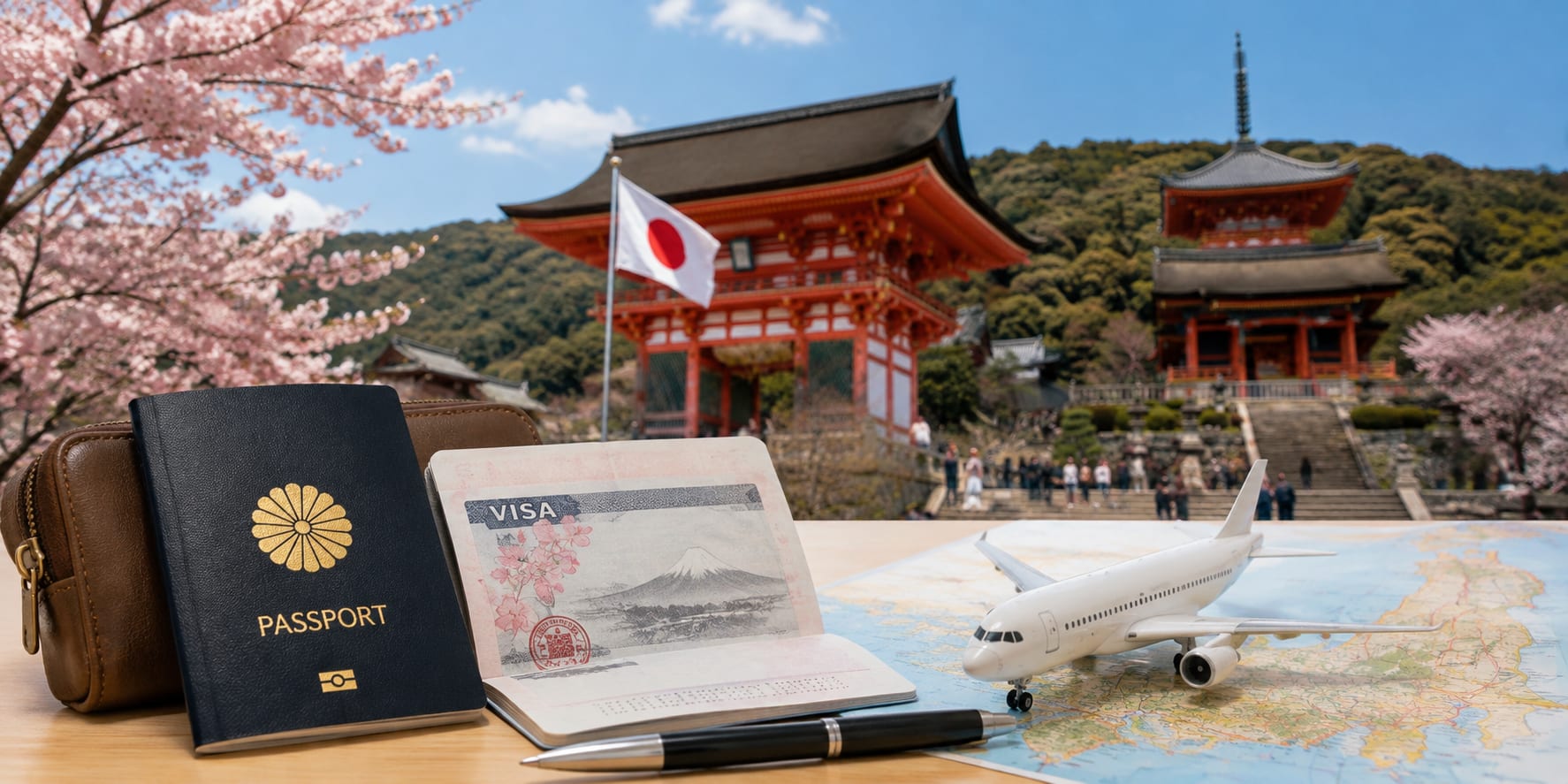
Japan Visa & Entry Requirements for International Travelers
Many travelers can visit Japan visa-free for short tourism stays, but requirements depend on your passport, nationality, stay length, and travel purpose.
Start Here
Do I need a visa to visit Japan?
Many travelers, including from the United States, Canada, the United Kingdom, most of Europe, Australia, New Zealand, Singapore, South Korea, Hong Kong, and Taiwan, can visit Japan without a tourist visa for a short stay. Others must apply for a visa in advance. Whether you need one depends on your passport, your travel purpose, and how long you plan to stay.
As of July 2026, visas cannot be obtained on arrival in Japan, and landing permission is still decided by the immigration officer at the port of entry, even for visa-exempt travelers.
Select your passport below for your exact requirement, then confirm it against MOFA's visa exemption list or your local Japanese embassy or consulate.
Key facts
Visa depends on passport
Japan does not use one tourism rule for every nationality.
Typical stay
Visa-free stays are often 90 days, but some passports receive 15 or 30 days instead.
Paid work allowed?
No. Visa-free entry and short-term visitor status do not permit paid work in Japan.
Visit Japan Web
An optional official pre-arrival tool for immigration, customs, and tax-free registration. It is not a visa and does not replace checking your passport's visa status.
Entry rules change
As of July 2026, MOFA is the authority to re-check before departure.
Verify before departure
Use the Japanese embassy or consulate for your place of residence when your case is not straightforward.
Do You Need a Visa?
Find Your Japan Visa Requirements
Select your passport to see whether you need a visa, how long you can stay, and important entry requirements for Japan.
Check Your Japan Visa Requirements
Select your passport to see whether you need a visa, how long you can stay, and important entry requirements for Japan.
Choose the passport that matches how you will enter Japan. If it is not listed exactly as expected, or you hold refugee travel documents, temporary passports, or passports with unusual endorsements, verify with the official MOFA list and your local Japanese mission before booking.
Travelers from many countries and regions, including the United States, Canada, the United Kingdom, Australia, New Zealand, Singapore, South Korea, and much of Western Europe, can usually visit Japan for short tourism stays without a visa. Others may need a visa in advance, or may qualify only if they hold a compliant ePassport, complete pre-registration, or meet passport-specific conditions. Travel purpose matters too: visa-free entry does not allow paid work.
United States
Visa required: No
Typical stay: 90 days
Short-term tourism, business, or visiting friends and relatives only; no paid work.
MOFA visa exemption listCanada
Visa required: No
Typical stay: 90 days
Short-term tourism, business, or visiting friends and relatives only; no paid work.
MOFA visa exemption listUnited Kingdom
Visa required: No
Typical stay: 90 days on arrival
Travelers who need more than 90 days may be eligible to request an extension through immigration before expiry.
MOFA note 8Australia
Visa required: No
Typical stay: 90 days
Short-term tourism and business visits only.
MOFA visa exemption listNew Zealand
Visa required: No
Typical stay: 90 days
Short-term tourism and business visits only.
MOFA visa exemption listSingapore
Visa required: No
Typical stay: 90 days
Short-term tourism and business visits only.
MOFA visa exemption listMalaysia
Visa required: No, with compliant ePassport
Typical stay: 90 days
MOFA says visa-free entry applies to ICAO-compliant ePassport holders; other passports may face strict examination or refusal.
MOFA note 3South Korea
Visa required: No
Typical stay: 90 days
Short-term tourism and business visits only.
MOFA visa exemption listTaiwan
Visa required: No, if passport has personal ID number
Typical stay: 90 days
Visa exemption is limited to Taiwan passport holders whose passport includes a personal ID number.
MOFA note 4Hong Kong
Visa required: No, for eligible HKSAR or BNO passports
Typical stay: 90 days
MOFA limits visa-free entry to HKSAR passports or BNO passports held by travelers with right of residence in Hong Kong.
MOFA note 5Germany
Visa required: No
Typical stay: 90 days on arrival
Travelers who need more than 90 days may be eligible to request an extension through immigration before expiry.
MOFA note 8France
Visa required: No
Typical stay: 90 days
Short-term tourism and business visits only.
MOFA visa exemption listItaly
Visa required: No
Typical stay: 90 days
Short-term tourism and business visits only.
MOFA visa exemption listSpain
Visa required: No
Typical stay: 90 days
Short-term tourism and business visits only.
MOFA visa exemption listNetherlands
Visa required: No
Typical stay: 90 days
Short-term tourism and business visits only.
MOFA visa exemption listSwitzerland
Visa required: No
Typical stay: 90 days on arrival
Travelers who need more than 90 days may be eligible to request an extension through immigration before expiry.
MOFA note 8Brazil
Visa required: No, with compliant ePassport
Typical stay: 90 days
MOFA limits visa-free entry to ICAO-compliant ePassport holders.
MOFA note 2Mexico
Visa required: No
Typical stay: 90 days on arrival
Travelers who need more than 90 days may be eligible to request an extension through immigration before expiry.
MOFA note 8India
Visa required: Usually yes
Typical stay: Short-term stay visa is generally for visits up to 90 days
MOFA does not list India on the visa exemption page. Confirm exact document and residency rules with the Japanese mission that covers your place of residence.
MOFA visa pagePhilippines
Visa required: Usually yes
Typical stay: Short-term stay visa is generally for visits up to 90 days
MOFA publishes country-specific guidance for Philippine nationals. Requirements vary by travel history, residency, and local mission procedure.
MOFA visa pageIndonesia
Visa required: No, with pre-registered compliant ePassport
Typical stay: 15 days
MOFA says visa-free entry applies only after ePassport registration with Japanese missions in Indonesia, and the registration remains valid for up to three years or until passport expiry.
MOFA note 1Thailand
Visa required: No, with compliant ePassport
Typical stay: 15 days
MOFA limits visa-free entry to ICAO-compliant ePassport holders.
MOFA note 2United Arab Emirates
Visa required: No, with compliant ePassport
Typical stay: 90 days
MOFA limits visa-free entry to ICAO-compliant ePassport holders.
MOFA note 2South Africa
Visa required: Usually yes
Typical stay: Short-term stay visa is generally for visits up to 90 days
MOFA does not list South Africa on the visa exemption page. Confirm current embassy or eVISA procedures before booking nonrefundable travel.
MOFA visa page
Visa-free travel to Japan
Visa-free entry usually covers short tourism, visiting friends or relatives, and limited business visits that do not involve being paid by a Japanese company.
Who may qualify
Many passport holders in North America, Europe, Oceania, and parts of Asia and Latin America qualify, but some exemptions only apply with compliant ePassports or special passport conditions.
Typical stay limits
MOFA currently lists 90 days for many visa-exempt passports, with shorter 30-day or 15-day allowances for some others.
What it does not allow
Visa-free entry does not authorize paid work, long stays, or using Japan as a workaround for a residence or employment plan.
Even when you are visa-exempt, you still need to satisfy entry inspection on arrival. Airlines may ask for onward travel proof, immigration can ask how long you will stay and where you will sleep, and your landing permission can still be limited by the rules attached to your passport.
As of July 2026, MOFA also reminds travelers that a visa is only one entry requirement and does not guarantee landing permission. That is why it is worth verifying your status again shortly before departure if your trip is still months away.
Travelers who may need a tourist visa
If your passport is not on the exemption list, or if your exemption has ePassport or registration conditions that you cannot meet, plan for an advance application.
What the process usually looks like
- Apply through the Japanese embassy, consulate, visa application center, accredited agency, or eVISA route specified for your place of residence.
- Prepare the passport, application form, photo, itinerary, proof of funds, and supporting documents requested locally.
- Expect extra document requests when your case involves self-employment, unclear income, frequent travel, a sponsor in Japan, or family circumstances.
Timing guidance
MOFA says visa processing takes approximately one week when all requirements are met, but that is general guidance, not a promise. Additional review, missing documents, appointment delays, or local outsourcing arrangements can add time, so apply well before you commit to nonrefundable flights.
Rules also vary by residency, not just passport. A traveler with an Indian passport living in Canada may face a different process from a traveler with the same passport applying from India.
- •Japan visas are issued outside Japan, not when you land and not after you arrive as a visitor.
- •Some travelers who need a visa may qualify for JAPAN eVISA depending on where they currently reside.
- •If your passport is close to expiry, renew it before applying so your visa and travel window are not tied to a soon-expiring document.
How to Apply for a Japan Tourist Visa
If your passport requires a visa, exact procedures vary by nationality and country of residence. Use these steps as a general roadmap, then confirm the details with the official mission handling your application.
Step 1: Check official requirements
Confirm whether your passport needs a visa and which category fits your trip. Use MOFA's visa exemption list or visa page, or check directly with the Japanese embassy, consulate, or visa application center responsible for your place of residence.
Step 2: Prepare required documents
Requirements vary by nationality, residence, and individual case, but applicants are commonly asked for a combination such as:
- Passport
- Application form
- Passport photo
- Travel itinerary
- Accommodation details
- Financial evidence
- Additional embassy-specific requirements
Treat this as a general starting point only. Always confirm the exact document list with the embassy, consulate, or application center handling your case.
Step 3: Submit your application
Applications are generally submitted through a Japanese embassy, a Japanese consulate, or an authorized visa application center. Some nationalities may also have access to an eVISA route depending on where they reside.
Step 4: Wait for processing
Processing times vary by mission, season, and application volume, so there is no single universal timeline. Apply well before your planned departure and avoid booking nonrefundable travel until your visa has been issued.
Step 5: Pay applicable fees
Visa fees vary by nationality, visa category, and location, and authorized visa application centers may add their own service fee on top of the visa fee itself. Always confirm current fees directly with the official embassy, consulate, or application center handling your application.
Step 6: Collect your passport
When your passport is returned, check that your name, passport number, visa validity dates, number of entries, and permitted length of stay are all correct before you travel.
Visa Exempt
- No visa application before travel, where applicable
- Check that your passport remains valid for your stay
- Follow the permitted stay length for your passport
- Use Visit Japan Web for a faster arrival, if applicable
Visa Required
- Apply before departure
- Prepare the required documents
- Submit your application through the correct channel
- Wait for processing and approval
- Verify your visa details once issued
A visa does not guarantee entry into Japan. Final admission is determined by immigration officers at the port of entry.
Always verify the latest requirements with the Japanese embassy, consulate, or official visa application center responsible for your country before applying.
Special cases to check before you fly
These situations often look simple at first and become stressful at check-in. A quick official re-check can save a canceled trip.
Transit through Japan
If you stay airside on a through-ticket, rules may be different from entering Japan. If you need to clear immigration, change airports, or stay overnight, verify visa and transit rules with your airline and the Japanese mission handling your residence area.
Minors traveling with one parent or alone
Each child needs their own passport. Airlines and transit countries may also ask for consent documentation, custody papers, or proof of the relationship, even when Japan itself does not list a universal extra document requirement.
Dual citizens
Use the passport that matches the status you intend to enter on, and keep the story consistent from check-in through arrival. Travelers who also hold Japanese nationality should confirm Japanese passport obligations directly with official authorities.
Past overstays or immigration issues
Previous overstays, refusals, arrests, or deportation history can trigger extra screening or different visa requirements. This is not a situation to leave until the week of departure.
Long stays
If you plan to stay more than 90 days, work, study, relocate, or join family for more than a short visit, you are no longer dealing with a standard tourist-entry question. Start with the correct visa category early.
Work, study, digital nomad, and paid activity
Tourist entry and visa-free entry do not authorize paid work. Japan has separate long-stay categories, including work, study, and digital nomad routes, each with its own eligibility and supporting documents.
Multiple-entry visits
Repeated short stays can draw extra questions if your travel pattern starts to look like de facto residence. Even when you are technically visa-exempt, each arrival is examined individually.
Arrival and entry process
Once your visa status is sorted, the airport side is usually simple when your documents and accommodation details are easy to show.
Passport and landing check
Bring your passport, return or onward travel details, and the address of your first accommodation. Landing permission is still decided by the immigration officer at the airport.
Immigration inspection
Travelers may be asked basic questions about purpose of visit, length of stay, and where they will stay. Keep bookings and itinerary details easy to show.
Customs declaration
Japan uses customs screening on arrival. Visit Japan Web can help you pre-register immigration and customs information before departure.
Visit Japan Web
Visit Japan Web is not the same thing as a visa. It is an optional but useful pre-arrival tool for many travelers, especially if you want to move through arrival formalities faster.
Airport tips
Save the address of your first hotel in a note you can access offline, keep your return or onward booking visible on your phone, and finish Visit Japan Web before departure if you want the smoothest airport experience.
Passport, customs, and JESTA
A few entry details that apply globally, regardless of which passport you hold.
Passport requirements
Japan does not apply a blanket six-month passport validity rule; MOFA requires your passport to remain valid for your intended stay. Airlines and any onward or transit country often enforce their own six-month rule and can deny boarding even when Japan itself would admit you, so check both before booking.
Customs declaration
Japan Customs requires an entry declaration for accompanied baggage. Visit Japan Web lets you complete this declaration online in advance and issues one QR code that covers both immigration and customs, scanned at the electronic gates after baggage claim. Paper declaration forms are still available if you do not pre-register.
JESTA (upcoming, not required yet)
In 2026, Japan's parliament passed the legal basis for JESTA, an electronic travel authorization for visa-exempt travelers modeled on the US ESTA. As of July 2026, the Immigration Services Agency targets introduction during fiscal year 2028. JESTA is not required for travel in 2026 or 2027; check the Immigration Services Agency for the current timeline before assuming it applies to your trip.
Official sources
For immigration and visa facts, this page relies on official Japanese government sources only.
MOFA visa information
Official overview of short-term stays, visa procedures, eVISA, and contact routes.
MOFA visa exemption list
The primary source for visa-free countries, permitted stay lengths, and passport-condition notes.
Japanese embassies and consulates
Use the mission that covers your place of residence for document lists, appointments, and local procedures.
Visit Japan Web
Official pre-arrival service for immigration and customs registration.
Immigration Services Agency of Japan
Official immigration authority for landing, status of residence, and in-Japan immigration procedures. Also the source for JESTA implementation timing.
JAPAN eVISA
Official portal for online visa applications where your nationality and place of residence qualify.
Japan Customs
Official guidance on passenger customs declarations and arrival procedures for accompanied baggage.
- •Do not treat visa-free entry and Visit Japan Web as the same thing; one is your legal entry basis and the other is an arrival convenience tool.
- •If your exemption depends on an ePassport, passport registration, or personal ID number, check that detail before you assume you are covered.
- •If your stay may turn into work, study, or a long visit, stop thinking in tourist-entry terms and confirm the correct long-stay route early.
Common Japan visa and entry questions
Next planning steps
Once entry is sorted, move on to the practical parts of the trip.