Ginkaku-ji (Silver Pavilion)
ExploreJapanDaily Editorial Team · Last updated: September 28, 2026
Ginkaku-ji, the Silver Pavilion, is a Zen temple garden at the north end of the Philosopher's Path. A visit is one walk through the grounds, past sand gardens, a pond and a hillside viewpoint, and the temple says it takes about 30 minutes. It is open every day, from 8:30 a.m. to 5:00 p.m. (9:00 a.m. to 4:30 p.m. in winter), and since April 2026 admission is ¥1,000.

- Area
- Okazaki / Higashiyama
- Best For
- Gardens, History, UNESCO Heritage, Philosopher's Path
Visiting Ginkaku-ji (Silver Pavilion)
Ginkaku-ji's official name is Jisho-ji. It began as the Higashiyama-den, the retreat of Ashikaga Yoshimasa, the eighth Muromachi shogun, who spent his life pursuing beauty; after his death it became a Rinzai Zen temple, now a branch of Shokoku-ji, like Kinkaku-ji.
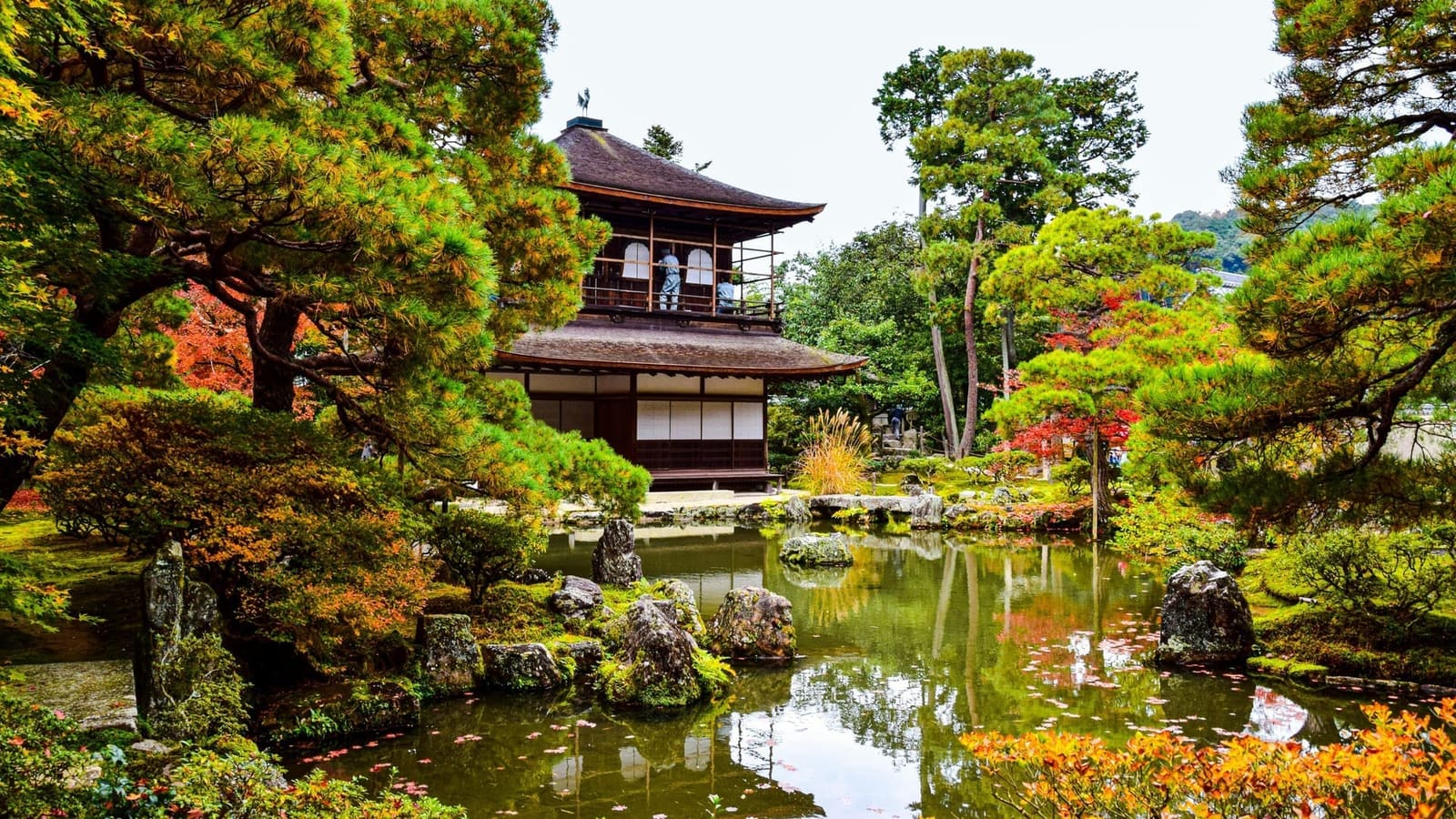
The pavilion was never covered in silver. The temple explains that the name "Silver Pavilion" was given in the Edo period, as a contrast to Kinkaku-ji's Golden Pavilion. The building is the Kannon Hall, a National Treasure and the only surviving multi-story building set in a garden from the Muromachi period. Visitors see it from the garden; it is not open inside.

A visit is one route through the grounds, set out below. The Philosopher's Path begins close to the temple, which makes Ginkaku-ji the usual start of a walk south to Nanzen-ji.
The route through Ginkaku-ji
Short answer
From the gate, walk the hedged approach to the reception, pass the sand gardens in front of the main hall, circle the pond below the Silver Pavilion, then climb the hillside path to the viewpoint before descending to the exit. The temple puts the whole visit at about 30 minutes.
Start
The Ginkakuji-gaki approach
A 50-meter corridor between hedges and bamboo fences, from the main gate to the central gate, where you pay.
In front of the main hall
Ginshadan and Kogetsudai
The stepped raked sand and the flat-topped sand cone, with the Silver Pavilion behind.
Next
The pond garden and the Silver Pavilion
The path circles the pond in front of the Kannon Hall, fed by the Sengetsusen falls at its southeast corner.
Up the slope
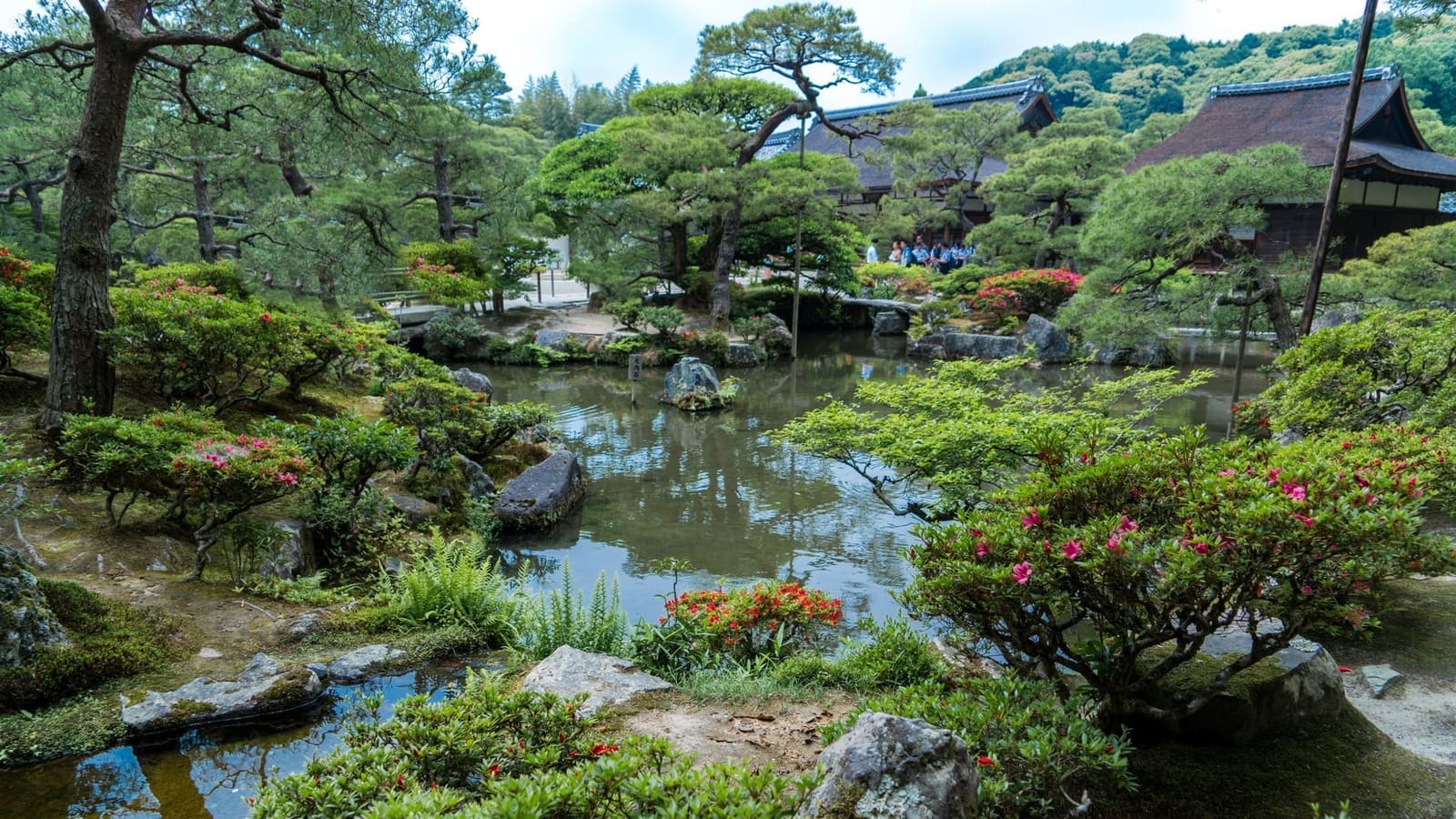
The hillside viewpoint
The path climbs the hillside past the ruins of the Sosentei and the Ochanoi tea well to a viewpoint over the garden. Some of these viewpoints are not wheelchair accessible.


When to go
Short answer
Arrive at opening, then walk the Philosopher's Path south. Hours change with the season, and the Togudo and Hojo open only during the spring and autumn special openings.
- March to November
- 8:30 a.m. to 5:00 p.m.; leave by 5:20 p.m.
- December to February
- 9:00 a.m. to 4:30 p.m.; leave by 4:50 p.m.
- Special openings
- In spring and autumn the Togudo, Hojo and Roseitei open to the public; check the temple's news page for dates.
Fitting Ginkaku-ji into a Kyoto day
Short answer
Ginkaku-ji is the start of the Philosopher's Path. Walk south to Nanzen-ji afterward, or pair it with Kinkaku-ji on City Bus 102 or 204.
Better on another day
Arashiyama
The Arashiyama Bamboo Grove is on the far western side of the city; give it another day.
Things to look for at Ginkaku-ji
How to Get to Ginkaku-ji (Silver Pavilion)
Ginkaku-ji is at the foot of the eastern hills, reached by city bus. From the stop, walk east up the approach lane to the gate, where the Philosopher's Path also begins.
- •City Bus 5, 7, 32, 102, 203 or 204 to Ginkakuji-michi.
- •Buses 102 and 204 link Ginkaku-ji and Kinkaku-ji directly.
- •Do not drive: there is no public temple parking.
Map
Best Time to Visit Ginkaku-ji (Silver Pavilion)
Best time to visit Ginkaku-ji (Silver Pavilion): At opening; then continue down the Philosopher's Path. Weekday mornings are generally quieter than weekends and public holidays.
- •At the 8:30 a.m. opening (9:00 a.m. in winter), before the garden fills.
- •Autumn maples around the pond and the Ginshadan are the classic view.
- •Spring and autumn special openings add the Togudo, Hojo and Roseitei.
Entry Fee & Hours
| Category | Price (JPY) | Approx. (USD) |
|---|---|---|
| High school student and older | ¥1,000 | ~$6.7 |
| Elementary and junior high student | ¥500 | ~$3.3 |
| Visitor with a disability | ¥100 | ~$0.7 |
- •Admission doubled on 1 April 2026, the first rise since 1994. There is no group discount, and the fee may change for special exhibitions.
- •The grounds can be visited in a wheelchair except for some viewpoints; there is an accessible toilet next to the gift shop.
Nearby Attractions
Places that pair with Ginkaku-ji

Philosopher's Path

Nanzen-ji Temple

Heian Shrine

Kinkaku-ji (Golden Pavilion)
- •Philosopher's Path (Starts close to the temple): The Philosopher's Path is a canal-side walk of about 2 kilometers in eastern Kyoto, between Ginkaku-ji and the Nanzen-ji area. It is named for the philosopher Nishida Kitaro, who walked it each morning, and is lined with cherry trees donated by the painter Hashimoto Kansetsu.
- •Nanzen-ji Temple (South, at the end of the Philosopher's Path): Nanzen-ji is the head temple of the Nanzen-ji school of Rinzai Zen, with a 22-meter Sanmon gate, a National Treasure abbot's hall and its tiger garden, and the red-brick aqueduct of the Lake Biwa Canal running through its grounds.
- •Heian Shrine (Southwest, in Okazaki): Heian Shrine was built in 1895 to honor Emperor Kanmu, who founded Kyoto, as a five-eighths-scale copy of the Heian palace's state halls. The shrine is free; its Meiji-era stroll garden, the Shin-en, is ticketed.
- •Kinkaku-ji (Golden Pavilion) (Across the city on City Bus 102 or 204): Kinkaku-ji, the Golden Pavilion, is a Zen temple in northwest Kyoto whose three-story relics hall has its upper two stories covered in gold leaf. Visitors see it across Kyoko-chi pond on a single walking route through the garden. The temple is a UNESCO World Heritage site.
Two ways to build a day around Ginkaku-ji
Both include the Philosopher's Path and differ in where the day starts.
Gold and silver
Both pavilions, linked by one bus.
9:00 a.m.
Kinkaku-ji at opening.
Late morning
City Bus 102 or 204 to Ginkakuji-michi, then Ginkaku-ji.
Afternoon
South along the Philosopher's Path to Nanzen-ji.
Eastern Kyoto on foot
A walking day from north to south.
8:30 a.m.
Ginkaku-ji at opening.
Morning
The Philosopher's Path south.
Afternoon
Nanzen-ji, then Heian Shrine.
Frequently Asked Questions
Planning Your Kyoto Trip?
See the full Kyoto destination guide or browse Japan itineraries that include this city.
See all Temples & Shrines across Japan →Explore all attractions in Kyoto or browse nearby destinations.
Back to Kyoto Guide →