Philosopher's Path
ExploreJapanDaily Editorial Team · Last updated: September 28, 2026
The Philosopher's Path is a walk of about 2 kilometers beside a canal in eastern Kyoto, between Ginkaku-ji in the north and Nyakuoji Shrine near Nanzen-ji in the south. It is a free public path, lined with cherry trees, and busiest in the blossom season. Most people walk it north to south, starting at Ginkaku-ji and finishing near Nanzen-ji.

- Area
- Okazaki / Higashiyama
- Best For
- Cherry Blossoms, Autumn Foliage, Walking, Photography
Visiting Philosopher's Path
The path follows a branch of the Lake Biwa Canal along the foot of the eastern hills, for about 2 kilometers between Ginkaku-ji and Nyakuoji Shrine near Nanzen-ji. It takes its name from Nishida Kitaro, a Kyoto University philosopher of the early 20th century who walked it every morning; it was first known as the "small path of contemplation", and was later chosen as one of Japan's 100 best roads.
Its cherry trees are the Kansetsu-zakura, donated by the Japanese-style painter Hashimoto Kansetsu, and they make it one of Kyoto's best-known blossom walks. One detail most visitors miss: the canal is man-made and flows from south to north, the opposite way to the nearby Shirakawa river.

The walk has no single sight. It links two major temples, Ginkaku-ji and Nanzen-ji, through quiet residential streets, and the route below sets it out north to south.
Walking the path, north to south
Short answer
Start at Ginkaku-ji, join the canal at the north end and follow it south for about 2 kilometers to Nyakuoji Shrine, then continue to Nanzen-ji. Allow about an hour for the walk alone.
Start
Ginkaku-ji
The Silver Pavilion sits above the north end of the path. Visit it first; the Ginkaku-ji guide covers the temple.
About 2 km
The canal path
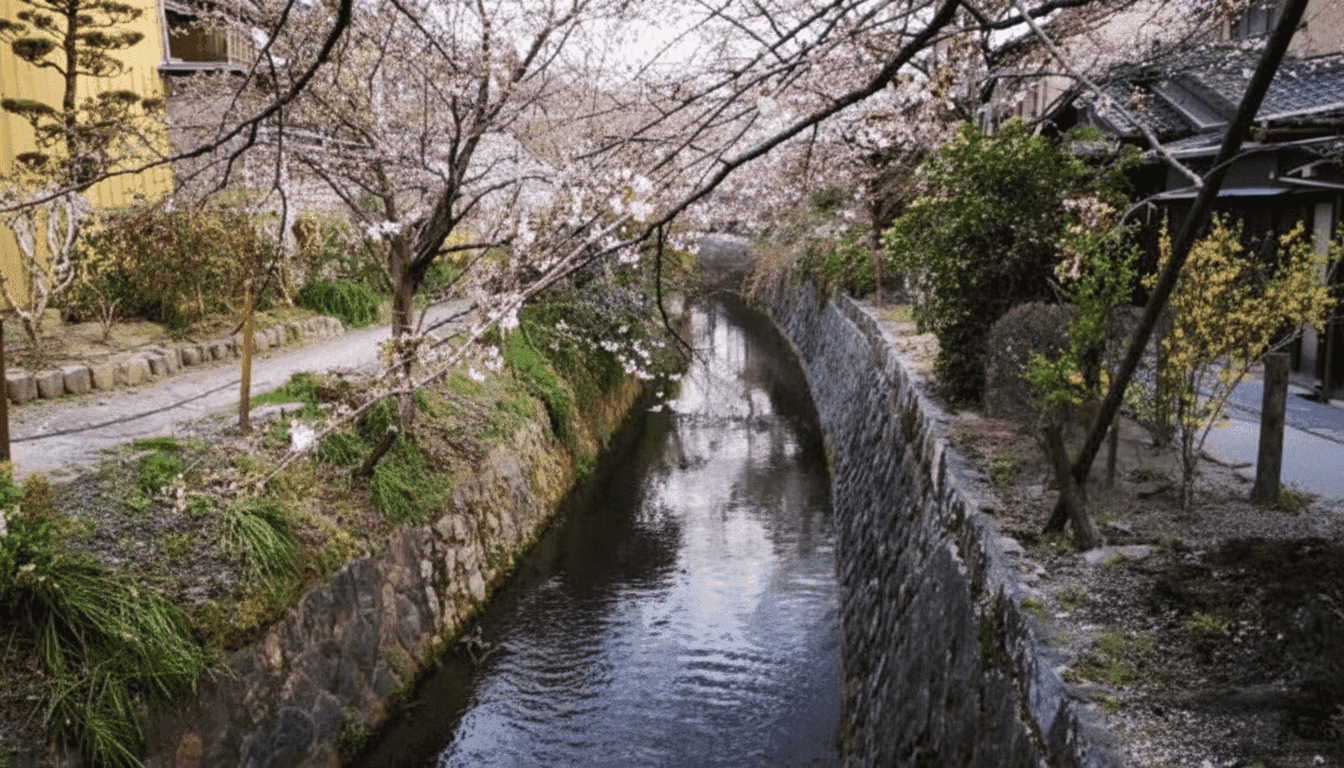
The walk follows the canal south under the Kansetsu cherries. The water runs the other way, north.
South end
Nyakuoji Shrine and Nanzen-ji
The path ends near Nyakuoji Shrine. Nanzen-ji is a short walk further south, with Keage Station beyond.

When to go
Short answer
The cherry blossom season is the path's high point and its busiest time; autumn color is the other draw. In either season, go early in the morning.
- Cherry blossom season
- Usually late March to early April in Kyoto. The busiest weeks of the year on the path.
- Autumn
- Color along the canal banks.
- Early morning
- The quietest time in any season.
Fitting the path into a Kyoto day
Short answer
The path is the link between Ginkaku-ji and Nanzen-ji. Kinkaku-ji pairs with the north end by bus; Heian Shrine and Okazaki lie just west of the south end.
Better on another day
Arashiyama
The Arashiyama Bamboo Grove is on the far western side of the city; give it another day.
What to look for on the Philosopher's Path
How to Get to Philosopher's Path
The path has no station. Start at the north end near Ginkaku-ji and walk south, or reverse it from the Nanzen-ji end.
- •City Bus 5 or 7 to Ginkakuji-michi for the north end.
- •Subway Tozai Line to Keage for the south end, about 20 minutes on foot.
- •Walk north to south to finish near Nanzen-ji, Okazaki and the way back to central Kyoto.
Map
Best Time to Visit Philosopher's Path
Best time to visit Philosopher's Path: Cherry blossom season (usually late March to early April) and autumn; early morning for a quieter walk. Weekday mornings are generally quieter than weekends and public holidays.
- •Cherry blossom season is the path's most famous and most crowded time.
- •Autumn brings color to the canal banks.
- •Early morning is quietest in any season.
Entry Fee & Hours
- •The path is free. It follows the canal without major climbs, but it is narrow in places and crowded with walkers in the blossom season.
Nearby Attractions
Places at either end of the walk

Ginkaku-ji (Silver Pavilion)

Nanzen-ji Temple

Heian Shrine

Kiyomizu-dera Temple
- •Ginkaku-ji (Silver Pavilion) (At the north end of the path): Ginkaku-ji, officially Jisho-ji, is a Rinzai Zen temple in eastern Kyoto built on the Higashiyama villa of the shogun Ashikaga Yoshimasa. Its Kannon Hall, the Silver Pavilion, and the Togudo are National Treasures, set in a garden of raked sand, pond and hillside. It is a UNESCO World Heritage site.
- •Nanzen-ji Temple (At the south end of the path): Nanzen-ji is the head temple of the Nanzen-ji school of Rinzai Zen, with a 22-meter Sanmon gate, a National Treasure abbot's hall and its tiger garden, and the red-brick aqueduct of the Lake Biwa Canal running through its grounds.
- •Heian Shrine (West of the south end, in Okazaki): Heian Shrine was built in 1895 to honor Emperor Kanmu, who founded Kyoto, as a five-eighths-scale copy of the Heian palace's state halls. The shrine is free; its Meiji-era stroll garden, the Shin-en, is ticketed.
- •Kiyomizu-dera Temple (South through Higashiyama, by bus or a long walk): Kiyomizu-dera is a Buddhist temple on the slopes of Mt. Otowa in eastern Kyoto, founded in 778. Its Main Hall stands on a wooden stage held up by 18 zelkova pillars, with a view across the city. The temple is a UNESCO World Heritage site.
Two ways to build a day around the Philosopher's Path
Both walk the path north to south and differ in what comes before it.
Gold, silver and the path
Two pavilions and the walk between.
9:00 a.m.
Kinkaku-ji at opening.
Late morning
City Bus 102 or 204 to Ginkakuji-michi, then Ginkaku-ji.
Afternoon
The Philosopher's Path south to Nanzen-ji.
Eastern Kyoto on foot
The path, then Okazaki.
Early morning
The path from the north end before the crowds.
Late morning
Afternoon
Heian Shrine in Okazaki.
Frequently Asked Questions
References
View references
Kyoto City Tourism Association
Kyoto Prefectural Tourism Federation
Planning Your Kyoto Trip?
See the full Kyoto destination guide or browse Japan itineraries that include this city.
See all Nature & Scenic Spots across Japan →Explore all attractions in Kyoto or browse nearby destinations.
Back to Kyoto Guide →