Odaiba
ExploreJapanDaily Editorial Team · Last updated: September 22, 2026 · Facts verified: September 22, 2026
- Area
- Odaiba / Minato
- Best For
- Views, Families, Shopping, Nightlife
Visiting Odaiba
Odaiba is a man-made island in Tokyo Bay, connected to central Tokyo by the Yurikamome monorail and Rainbow Bridge. It's a waterfront district built for leisure rather than historic landmarks: shopping malls, a science museum, an indoor amusement park, and wide promenades with some of the best skyline views in the city. Most visitors treat it as a half-day or evening addition to a Tokyo itinerary rather than a full day on its own.
It suits travelers who want a slower-paced few hours between temples and crowded shopping streets, families with children who need indoor space and open plazas to move around in, and anyone chasing a Rainbow Bridge photo at sunset. Travelers short on time, or uninterested in shopping malls and museums, can reasonably treat Odaiba as optional.
The island was built from landfill starting in the 1990s as part of a planned Tokyo Teleport Town development that stalled after Japan's economic bubble burst. What was meant to become an office and residential hub instead grew into an entertainment and shopping district through the 2000s, which is why Odaiba still feels more spread out and less dense than central Tokyo neighborhoods.
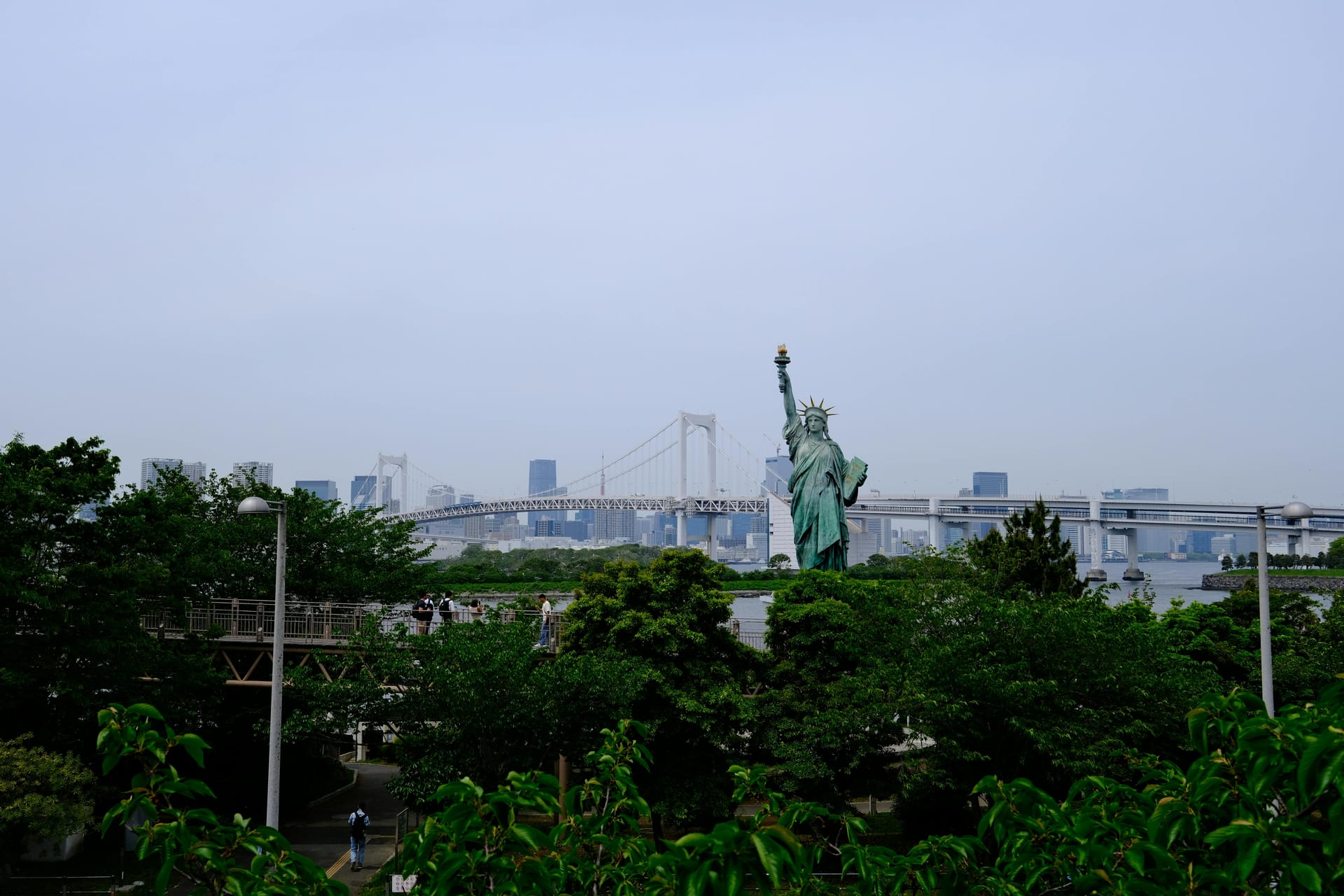
The waterfront promenade along Tokyo Bay is Odaiba's strongest feature regardless of what else is on the itinerary. Rainbow Bridge stretches across the water toward central Tokyo, and a full-scale replica of the Statue of Liberty stands near Odaiba Marine Park, a leftover from a 1998 France-Japan friendship exhibit that proved popular enough to stay permanently. The view is best in late afternoon into sunset, when the bridge's cables catch the light and the skyline starts lighting up across the bay.
The Yurikamome Line, an elevated driverless train from Shimbashi Station, is part of the appeal: it crosses Rainbow Bridge on an automated track with unobstructed views of the bay, and most visitors count the ride itself among Odaiba's highlights rather than just transportation.
DiverCity Tokyo Plaza and AQUA CiTY Odaiba anchor the district's shopping, with roughly 150 stores, restaurants, and entertainment tenants between them. Next to Aqua City, Fuji Television's headquarters building, recognizable by its silver sphere observation deck, is one of Odaiba's most distinctive landmarks. DiverCity's Gundam Base Tokyo store remains a permanent draw for model kit collectors; the life-size Unicorn Gundam statue that stood outside since 2017 ended its public display on August 31, 2026, so travelers visiting for the statue specifically should check its current status before making a special trip.

Miraikan, the National Museum of Emerging Science and Innovation, is Odaiba's main indoor draw for families and science-minded visitors, though it's fully closed for refurbishment from October 1, 2026 to April 22, 2027. Tokyo Joypolis, SEGA's indoor amusement park inside DECKS Tokyo Beach, stays open through that window and works as an indoor alternative.
Odaiba Marine Park has a sandy beach facing the bay, but swimming isn't allowed; Tokyo Bay's water quality doesn't meet the standards Japan's Ministry of the Environment sets for bathing. The beach still works well for a waterfront walk, a bench with a view, or watching the sunset with Rainbow Bridge as a backdrop.
Odaiba changes noticeably after dark. Rainbow Bridge's cable lighting switches on at dusk, the DiverCity and Fuji Television buildings light up, and the promenade thins out enough to make photography easier than during the day. Many visitors deliberately time their visit to overlap sunset and the first hour after dark.
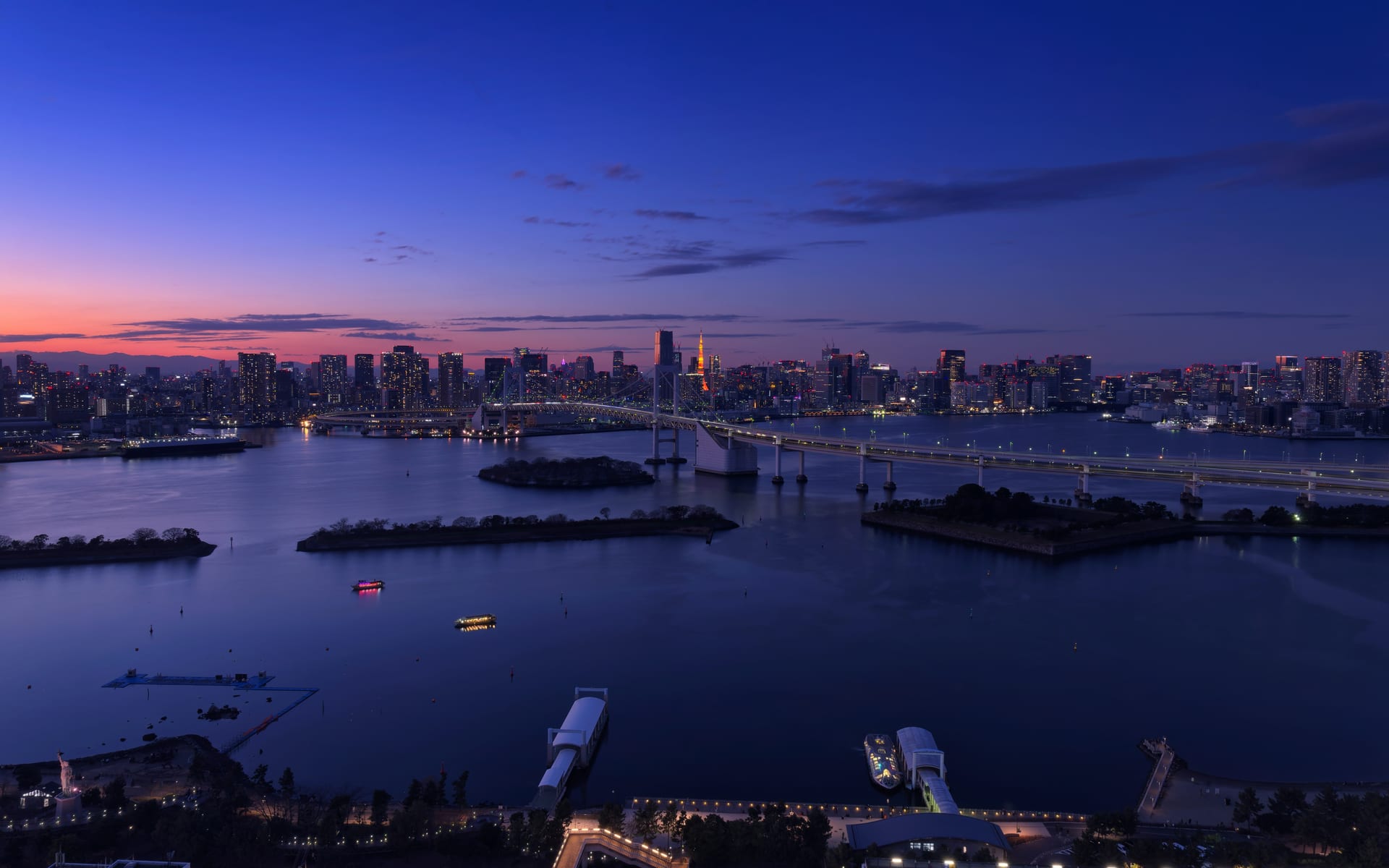
Odaiba doesn't have the historical density of Asakusa or the shopping intensity of Shibuya and Shinjuku, and that's largely the point: it's a place to slow down for an afternoon or evening rather than check off a list of landmarks.
Things to Do at Odaiba
How to Get to Odaiba
Odaiba is located on a large artificial island in Tokyo Bay and is easily accessible from central Tokyo by train, monorail, water bus, and taxi. Although the district feels separated from the rest of the city by the bay, transportation connections are modern, efficient, and surprisingly scenic.
For many visitors, the journey to Odaiba becomes part of the experience itself, especially when arriving across Rainbow Bridge with panoramic views of Tokyo Bay and the skyline.
- •Nearest station: Odaiba-Kaihin-Koen Station or Daiba Station, Yurikamome Monorail Line; Tokyo Teleport Station, Rinkai Line
- •IC cards (Suica, Pasmo, or ICOCA) are accepted on trains, subways, and buses throughout Japan. Tap in and out at every gate.
- •Avoid traveling during rush hour on weekdays: 7am to 9am and 5pm to 8pm. Trains are significantly more crowded.
- •Google Maps provides accurate real-time transit directions in Tokyo. Download offline maps before you arrive.
For IC cards, tickets, and full transit basics for Tokyo, see the complete transportation guide.
See the Getting Around Tokyo guide →Map
Best Time to Visit Odaiba
Best time to visit Odaiba: Late afternoon into evening for Rainbow Bridge and sunset views. Weekday mornings are generally quieter than weekends and public holidays.
- •Best time to visit: Late afternoon into evening for Rainbow Bridge and sunset views
- •Arriving on a weekday morning avoids the largest crowds. Weekends and public holidays are significantly busier.
- •Spring (late March to early May) and autumn (October to November) are the most popular seasons for visiting Tokyo.
- •Golden Week (late April to early May) is the busiest week of the year in Japan. Book accommodation and tickets well in advance.
The waterfront and Rainbow Bridge are lit with seasonal illuminations, and the bridge lighting changes color after dark.
Odaiba's beach and waterfront promenade are popular for evening walks once the daytime heat eases.
Entry Fee for Odaiba
- •Odaiba itself has no admission fee; the waterfront, malls, and Gundam Base Tokyo are free to enter. Individual attractions inside the district, including Miraikan, Tokyo Joypolis, and Round1 Stadium, charge separate admission.
- •teamLab Planets is a separately ticketed attraction in neighboring Toyosu, not inside Odaiba.
- •Tokyo Bay's water quality does not meet Japan's official bathing standards, so swimming is not permitted at Odaiba Marine Park's beach.
- •The waterfront promenade between Symbol Promenade Park, Odaiba Marine Park, and DECKS Tokyo Beach is flat, paved, and accessible by ramps and elevators for wheelchairs and strollers.
- •The Yurikamome monorail serving the area is wheelchair accessible at all stations.
Nearby Attractions
Combine with Odaiba on the same day

teamLab Planets

Tokyo Tower

Ginza

Toyosu Market

Rainbow Bridge

Miraikan
- •teamLab Planets (Around 10–15 minutes by train): teamLab Planets is an immersive digital art museum in Toyosu where visitors walk barefoot through vast rooms of sensory light, water, and flower installations. It is one of Tokyo's most visually spectacular modern experiences.
- •Tokyo Tower (Around 20–30 minutes by train): Tokyo Tower is an iconic 333-meter orange-and-white lattice tower that has symbolized Tokyo since 1958. It offers observation decks with views over the city and Tokyo Bay.
- •Ginza (Around 20–30 minutes by train): Ginza is Tokyo's most prestigious shopping and dining district, featuring flagship stores of the world's top luxury brands alongside Japanese department stores and galleries. It is Tokyo's equivalent of the Champs-Elysees.
- •Toyosu Market (Around 10–15 minutes by train): Toyosu Market is Tokyo's modern wholesale seafood market in Koto, the successor to Tsukiji's wholesale trading and tuna auctions since 2018. Visitors can watch the tuna auction from an observation deck, eat at relocated Tsukiji-area sushi restaurants, and browse the Uogashi Yokocho shops.
- •Rainbow Bridge (Directly connected to Odaiba): Rainbow Bridge's free pedestrian walkway, the Rainbow Promenade, lets you walk across Tokyo Bay between Shibaura and Odaiba in about 25-40 minutes, choosing a North Route (Tokyo Tower and skyline) or South Route (Tokyo Bay and Odaiba) view.
- •Miraikan (Around 15-20 minutes by train): Miraikan, Tokyo's National Museum of Emerging Science and Innovation in Odaiba, will be fully closed for refurbishment from October 1, 2026 to April 22, 2027. While open, it offers hands-on robotics, AI, and space exhibits centered on the Geo-Cosmos globe.
Suggested Itinerary
Pair Odaiba with these nearby stops for a full day in Odaiba / Minato.
Frequently Asked Questions
Planning Your Tokyo Trip?
See the full Tokyo destination guide or browse Japan itineraries that include this city.
See all Shopping & Entertainment across Japan →Explore all attractions in Tokyo or browse nearby destinations.
Back to Tokyo Guide →