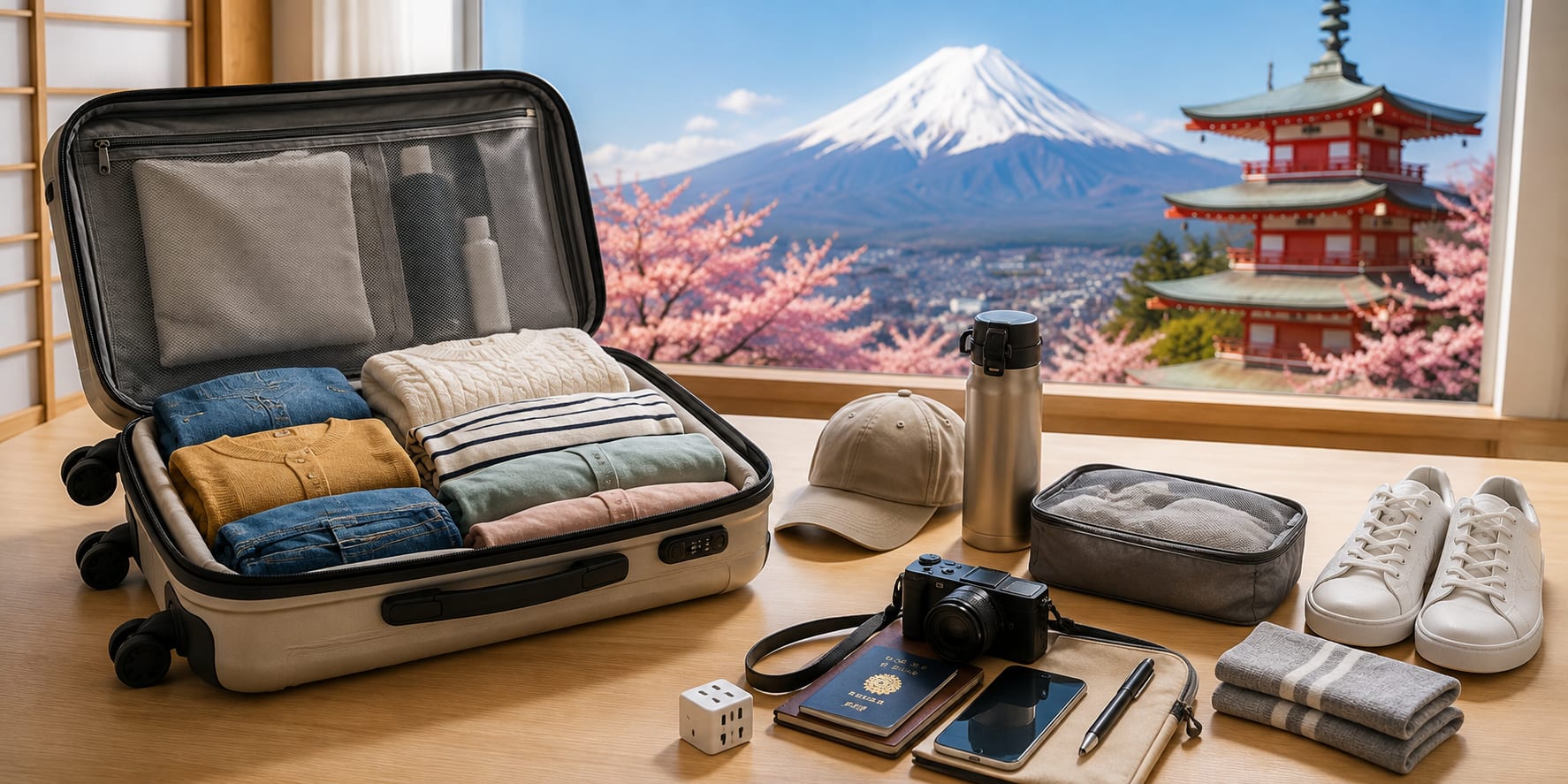
What to Pack for Japan
A complete checklist, what changes by season and destination, and what to buy after you land instead of packing it.
What Should You Pack for Japan?
A handful of essentials, comfortable walking shoes, a fee-free card plus some cash, connectivity, and copies of key documents, work for any Japan trip regardless of season. Beyond that, what you pack changes by when you're traveling, where in Japan you're going, and how many cities you're covering. Japan also makes it easy to pack lighter than you would for most destinations: convenience stores and drugstores are everywhere, coin laundries are common, and luggage forwarding can move your suitcase between hotels for you.
What should I pack for Japan? Comfortable walking shoes, a no-foreign-fee card plus some cash, an eSIM, and copies of your travel documents are essential year-round. Clothing needs change by season and one bag you can carry yourself is easier to manage than a large suitcase. See the full checklist and seasonal guide below.
Jump to the Full Checklist →Why Packing for Japan Is Different
Six things about traveling in Japan that should shape what's in your bag
You will walk far more than at home
Most sightseeing days involve 15,000+ steps between train transfers, temple grounds, and city blocks. Shoe comfort matters more than shoe style here.
Trains, not a rental car, move you around
Bulky, hard-sided luggage is genuinely awkward on stairs, platforms, and standard train doors. A bag you can carry yourself, one-handed, up a flight of stairs, changes your whole trip.
Weather swings hard within a single trip
A spring or autumn day can shift 15-20°F from morning to afternoon, and summer humidity changes how clothing should perform, not just what temperature it should suit.
Convenience stores stock almost everything
7-Eleven, Lawson, and FamilyMart locations are everywhere and open 24 hours, stocking toiletries, basic medicine, chargers, and umbrellas, so you can pack lighter than you think.
Coin laundries are genuinely common
Most hotel districts and many ryokans have a coin-op laundry nearby or on-site, which means a week-long trip does not require a week of clothing to match.
Hotel rooms run smaller than Western standards
A single large suitcase can be genuinely difficult to open and unpack in a compact city hotel room. A smaller bag, or a bag you can partially unpack into provided shelving, is easier to live out of.
What to Pack, By Season
Clothing, footwear, and accessories for each season, plus the weather driving them
Spring
46-64°F (8-18°C), warming through May
- Clothing:
- A light jacket or cardigan for cool mornings and evenings; A mix of short and long sleeve tops for warm afternoons by May.
- Footwear:
- Comfortable walking shoes, temple grounds and blossom-viewing parks add up fast.
- Accessories:
- A compact umbrella or light rain jacket, both April and May see rain on roughly a third of days.
Single days can swing close to 18°F (10°C) in early spring. Pack layers you can add and remove rather than one jacket weight for the whole trip.
Full spring guide →Summer
68-90°F (20-32°C), high humidity on the mainland
- Clothing:
- Lightweight, breathable, moisture-wicking fabrics over cotton, which stays wet with sweat all day.
- Footwear:
- Sturdy, broken-in shoes with real grip if any part of the trip includes a Mt. Fuji climb (staffed season is early July to early September).
- Accessories:
- A wide-brim hat, sunglasses, and sunscreen; A portable handheld fan or cooling towel, sold everywhere once summer starts; A compact umbrella that doubles as sun protection.
June is rainy season with intermittent rather than constant rain. July and August turn genuinely hot and humid, especially in cities; Hokkaido stays noticeably cooler and drier.
Full summer guide →Autumn
45-75°F (7-24°C), cooling through November
- Clothing:
- A mix of short and long sleeve layers for September and early October's still-warm afternoons; A packable insulated layer for cold late-November mornings and evenings.
- Footwear:
- Comfortable, broken-in walking or light hiking shoes for foliage viewing on trails like Nikko, Hakone, and Kamikochi.
- Accessories:
- A light rain layer, September still carries real typhoon-season humidity and showers; Gloves and a light scarf if any part of the trip runs into late November.
The morning-to-afternoon temperature swing widens as the season goes on, so a base layer that works across that range matters more in late autumn than early autumn.
Full autumn guide →Winter
32-50°F (0-10°C), colder in Hokkaido and the mountains
- Clothing:
- A real layering system, a thermal base layer, an insulating mid-layer, and a wind- and waterproof outer shell, rather than one heavy coat.
- Footwear:
- Insulated, waterproof boots with real tread for ice and packed snow.
- Accessories:
- Gloves, a hat, and a scarf for wind chill on the coast and in the mountains; Lip balm, moisturizer, and tissues, Japan's winter air is very dry.
Buildings and trains run warm even on the coldest days, so indoor layers you can shed easily matter as much as the outer layer.
Full winter guide →The Complete Packing Checklist
Organized by category, for any Japan trip
Travel documents
- •Passport with at least 6 months' validity remaining
- •A printed and a digital photo of your passport photo page
- •Proof of onward travel and hotel confirmations, printed or saved offline
- •Travel insurance policy number and emergency line, saved offline
Electronics
- •Phone and charging cable
- •A portable charger (10,000mAh or larger)
- •eSIM installed before departure, or a physical SIM/pocket WiFi device
- •Camera plus extra memory cards or batteries, if not relying on your phone
Clothing
- •Season-appropriate layers, see the seasonal guide above
- •Comfortable, broken-in walking shoes
- •Slip-on shoes are useful, since shoes come off often at temples, ryokans, and some restaurants
- •One slightly dressier outfit for a nicer dinner or a ryokan stay
Toiletries
- •Travel-size basics for arrival night, restock at any drugstore after that
- •Your preferred deodorant, Japanese formulations run milder
- •Contact lenses and solution, if you rely on a specific brand
Medication
- •All prescription medication for the full trip plus a few extra days, in original packaging
- •A copy of the prescription or a doctor's letter
- •Check Japan's import rules before you pack anything beyond routine maintenance medication, see below
Day bag
- •A compact daypack for trains and temples
- •A refillable water bottle
- •Hand sanitizer and a small pack of tissues
- •A compact umbrella
Money
- •A card with no foreign transaction fee
- •A backup card in case one is declined
- •¥10,000-20,000 in cash, small shops, shrines, and some restaurants remain cash-only
Travel accessories
- •Packing cubes to keep a smaller bag organized
- •A packable tote for shopping runs
- •A small luggage scale, useful for domestic flights with strict weight limits
- •A few ziplock bags for wet items or onsen toiletries
What You Can Buy After You Land
Pack less by relying on convenience stores, drugstores, and department stores for these
Umbrellas
Convenience stores and 100-yen shops sell compact umbrellas for a few dollars, no need to pack a spare.
Toiletries
Drugstores like Matsumoto Kiyoshi stock every basic, plus Japan-specific skincare worth trying once you're there.
Chargers & cables
Any convenience store or electronics retailer carries standard charging cables if yours is lost or breaks.
Clothing basics
Uniqlo and GU locations are everywhere for a forgotten layer, though sizing runs smaller, see below.
Basic medicine
Pain relievers, cold medicine, and stomach remedies are easy to find, though dosages and familiar Western brand names often differ.
SIM & eSIM
Airport kiosks sell physical SIMs on arrival, though an eSIM set up before departure gets you connected faster, see our eSIM guide.
Snacks
Convenience stores and department store food halls make packed snacks from home largely unnecessary.
What to Bring From Home Instead
Anything genuinely difficult to replace once you've arrived
Prescription medication
Some common medications, including certain ADHD stimulants and some allergy or cold medicines with pseudoephedrine or codeine, are restricted or require an import certificate (yakkan shoumei) in Japan. If you take anything beyond routine maintenance medication, check Japan's customs rules before you pack it rather than assuming it travels the same way it does at home.
Specialty toiletries
A specific skincare, haircare, or cosmetics brand you rely on may not have an exact match locally. General basics are easy to replace; a specific product is not.
Large shoe sizes
Clothing and shoe sizing runs smaller than US standards. Above roughly a US men's 11 or women's 10, your size gets noticeably harder to find outside a handful of specialty or import stores.
Specific dietary products
Gluten-free, specific protein or dietary bars, and particular baby formula brands are not reliably stocked. Bring what you need rather than plan to find an equivalent.
Medical equipment
A CPAP machine or other personal medical equipment should travel with you; US and Canadian voltage (100V) is compatible, so no converter is needed, but bring your own cables and any replacement parts.
Luggage Strategy: How Much to Bring
Carry-on vs. checked luggage, and how to travel lighter than you would elsewhere
| Factor | Carry-On Only | Checked / Larger Suitcase |
|---|---|---|
| Best for | Trips under 10 days, or any trip using coin laundries | Longer trips, families, or travelers who plan to shop heavily |
| Mobility on trains and stairs | Easy, one hand, most stations | Harder; confirm elevator access at smaller or rural stations |
| Laundry needed | Every 3-4 days | Rarely, if at all |
| Room for souvenirs | Limited unless you plan for it | Built in from the start |
| Domestic flight fees | Avoided entirely | Some budget domestic carriers charge for checked bags, verify limits before booking |
Use coin laundries to pack lighter
Most hotel neighborhoods and many ryokans have a coin-op laundry within easy walking distance. Packing for 4-5 days of outfits and washing partway through a longer trip is standard practice, not a compromise.
Leave room for shopping
Pack your bag at roughly 80% capacity, or bring a packable duffel, so souvenirs and Uniqlo/Don Quijote finds have somewhere to go on the way home.
Check the Shinkansen oversized-luggage rule
On the Tokaido, Sanyo, and Kyushu Shinkansen, any bag with dimensions summing to over 160cm needs a free advance seat reservation with luggage space, or you risk an on-the-spot fee. See our transportation guide before booking seats for a multi-city rail trip.
Use station coin lockers to explore hands-free
Most stations have coin lockers in small, medium, and large sizes, typically ¥300-700 per day. Useful for a day trip or a layover between checking out of one hotel and checking into the next.
Consider luggage forwarding (takkyubin) for multi-city trips
Yamato Transport and other delivery companies will move a suitcase between hotels or to the airport while you travel with a day bag. It is not overnight: Yamato asks you to send a bag to a hotel two days before check-in, and the price depends on the size of the case and the distance.
Ask about hotel luggage forwarding
Many hotels and ryokans can arrange forwarding at the front desk. Ask the day before you want to send, and check that your next hotel will accept the bag before you arrive.
Packing Advice by Traveler Type
The same trip, packed differently depending on who's going
Solo travelers
A single carry-on-sized bag keeps you mobile between cities and easy to manage on stairs. Use a station coin locker to explore hands-free on arrival or departure days.
Families
Pack an extra day bag for kids' snacks and a change of clothes, and consider a carrier over a stroller for stations without elevators. Coin laundries make packing lighter for kids worthwhile too.
Luxury travelers
Bring one dressier layer for kaiseki dinners and higher-end ryokans. Luggage forwarding between properties is worth the cost here, so you are not managing bags between check-out and check-in.
Budget travelers
Packing cubes and a laundry routine let you travel with one bag for a longer trip. Hostels and capsule hotels also have limited luggage storage, so a compact bag matters more than usual.
Business travelers
A structured carry-on plus one business-casual layer covers most short trips. US and Canadian devices and plugs work without an adapter, so pack accordingly for other markets if your trip continues elsewhere.
Winter travelers
Prioritize a real layering system and waterproof, insulated boots over a single heavy coat. See our winter guide for region-by-region cold.
Summer travelers
Moisture-wicking fabrics and a portable fan matter more than extra clothing. See our summer guide for the heat and humidity by region.
- •US and Canadian devices work in Japan without a power adapter or voltage converter
- •Clothing and shoe sizing runs smaller than US standards; pack what you need rather than planning to buy it there
- •Coin laundries are common enough that a week-long trip does not require a week of clothing
- •Luggage forwarding (takkyubin) can move your suitcase between hotels, but send it two days before your next check-in
- •Some prescription medications require an import certificate in Japan; check before you pack anything beyond routine maintenance drugs
- •Set up your eSIM before departure so navigation works from the airport onward
- •Pack your bag at roughly 80% capacity to leave room for souvenirs
- •Check the Shinkansen oversized-luggage reservation rule before a multi-city rail trip
- •Check the seasonal guide for your travel dates for a season-specific clothing list
Common Packing Mistakes
Specific, avoidable errors that make a Japan trip harder than it needs to be
Overpacking clothing "just in case"
Instead: plan on coin laundry every 3-4 days for trips over a week, and pack for roughly half your actual trip length in clothing.
Packing for one temperature instead of the whole day
Instead: bring layers you can add and remove, especially in spring and autumn when a single day can swing 15-20°F.
Bringing brand-new, unbroken-in shoes
Instead: wear your walking shoes for at least a few weeks before departure. Sightseeing days regularly hit 15,000+ steps.
Assuming Japan is cash-only or card-only
Instead: carry both. Cards work at hotels and chains; cash is still needed for small shops, shrines, and some restaurants.
Bringing a voltage converter for US or Canadian devices
Instead: skip it. Japan's 100V supply and Type A plug are compatible with US and Canadian electronics as-is.
Leaving no room for souvenirs
Instead: pack your bag at roughly 80% capacity, or bring a packable duffel for the trip home.
Checking one oversized suitcase for a multi-city rail trip
Instead: a bag you can carry yourself up a flight of stairs is far easier to live with than a bag that needs an elevator you can't always find.