Yuigahama Beach
ExploreJapanDaily Editorial Team · Last updated: September 22, 2026 · Facts verified: September 22, 2026
- Area
- Yuigahama, Kamakura
- Best For
- Sunset views, Mount Fuji sightings, Summer swimming, Coastal walks
Visiting Yuigahama Beach
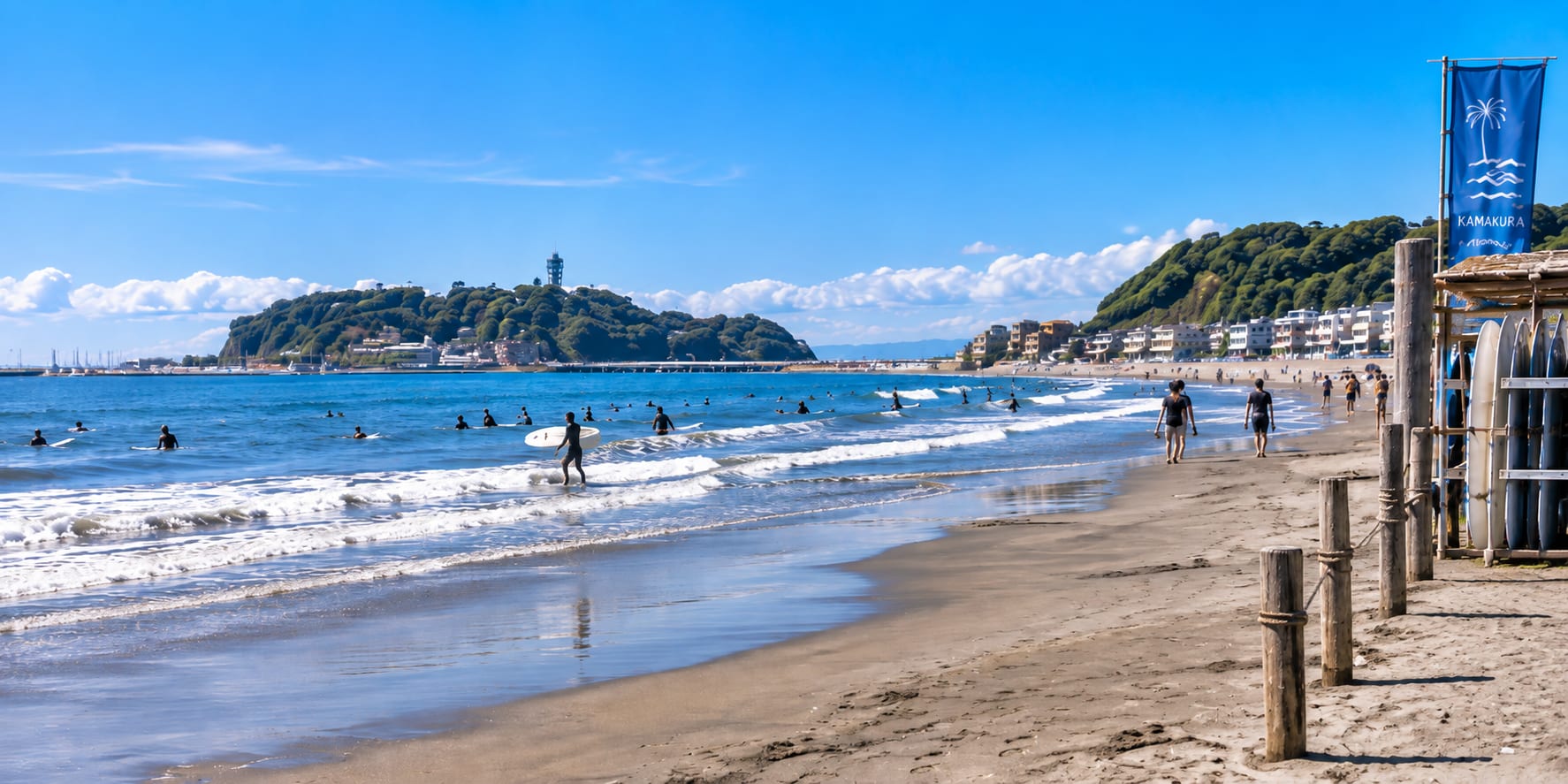
Yuigahama Beach is Kamakura's main public beach, a wide, dark-sand shoreline on Sagami Bay a short walk from the Hasedera and Great Buddha temple cluster. The beach itself is free and open year-round, at any hour, with no gate and no admission. That is a different fact from the official swimming season, a specific window set annually by Kamakura City and the Kamakura Tourism Association, when lifeguards, flagged swim areas, and seasonal beach houses operate. Confusing the two is the single most common misunderstanding about this beach, and this guide keeps them separate throughout.
Outside the swim season, Yuigahama is simply a public shoreline: walkable, unstaffed, and largely without beach-specific facilities. Visitors come for a coastal walk, a sunset that looks west across Sagami Bay toward Enoshima, and on clear autumn and winter days, a view of Mount Fuji on the horizon. Inside the swim season, typically early July through late August, the beach changes character entirely. Lifeguards watch flagged swimming areas, seasonal beach houses (umi no ie) sell food and drinks and rent showers and shade, and a designated Soft Board Area accommodates beginner surfers and bodyboarders. The exact dates move each year, so travelers planning a swim should confirm current-season dates rather than assume a prior year's calendar.
The shoreline has served Kamakura for centuries. During the Kamakura period (1185-1333), the beach then known as Maehama was used as a training ground for horseback archery and saw fighting during conflicts in 1180, 1333, and 1416. The ruling Minamoto clan is said to have used the shore for ritual purification before shrine visits, and the Buddhist priest Nichiren was famously put on a boat here en route to an execution that was ultimately averted. In 1232, the priest Oamidabutsu built Wakaejima, an artificial breakwater used to land timber for Kamakura's temples and shrines, a structure that remained in use through the Edo period. Some tourism material nicknames the beach the "Ginza of the Sea," a phrase repeated often enough to be worth mentioning but not traced to a single confirmed source, so it is included here only as a passing note, not a headline claim.
Yuigahama has held Blue Flag certification, an international water-quality and safety standard, since 2016, making it one of Japan's and Asia's first Blue Flag beaches. A beach in Fukui Prefecture makes a similar first-in-Asia claim for the same certification year, so rather than picking a winner, it is fairer to say both beaches were certified in that same initial cohort.
Geographically, "Yuigahama" refers to the western and central stretch of a longer, roughly 3.2-kilometer shoreline that continues east into Zaimokuza Beach, a distinct, separately named beach that competitor sites often describe as Yuigahama's quieter neighbor. To the west, the headland of Inamuragasaki marks the end of the sand and offers its own viewpoint, but it is not part of Yuigahama Beach itself and is not a swimming spot. Travelers researching "Kamakura beaches" broadly, rather than Yuigahama specifically, are better served by the Kamakura destination hub or by continuing on to Enoshima Island, a short Enoden ride further west.
For most visitors, Yuigahama works best as an add-on to a Kamakura temple day rather than a standalone destination. Its real advantage is proximity: a few minutes on foot from Hasedera and a similarly short walk or train ride from the Great Buddha, making it easy to fold fifteen or twenty minutes of coastline into a day that is otherwise built around temples. Swimmers and families visiting specifically for the beach should treat the season dates as the trip's anchor fact and confirm them close to travel, since Kamakura City sets them fresh each year.
Things to Do at Yuigahama Beach
How to Get to Yuigahama Beach
Yuigahama Beach is reached most directly by the Enoshima Electric Railway (Enoden), with Kamakura Station as the main JR gateway from Tokyo and Yokohama.
- •Nearest station: Yuigahama, Wadazuka, or Hase Station (Enoden), approx. 5 min walk; Kamakura Station, approx. 15-20 min walk
- •IC cards (Suica, Pasmo, or ICOCA) are accepted on trains, subways, and buses throughout Japan. Tap in and out at every gate.
- •Avoid traveling during rush hour on weekdays: 7am to 9am and 5pm to 8pm. Trains are significantly more crowded.
- •Google Maps provides accurate real-time transit directions in Kamakura. Download offline maps before you arrive.
Map
Best Time to Visit Yuigahama Beach
Best time to visit Yuigahama Beach: Sunset and Mount Fuji viewing: autumn through winter. Swimming: official season only, verify current dates.. Weekday mornings are generally quieter than weekends and public holidays.
- •Best time to visit: Sunset and Mount Fuji viewing: autumn through winter. Swimming: official season only, verify current dates.
- •Arriving on a weekday morning avoids the largest crowds. Weekends and public holidays are significantly busier.
- •Spring (late March to early May) and autumn (October to November) are the most popular seasons for visiting Kamakura.
- •Golden Week (late April to early May) is the busiest week of the year in Japan. Book accommodation and tickets well in advance.
The official swimming season: lifeguard-watched flagged swim areas, seasonal beach houses, and a designated Soft Board Area for beginner surfers, alongside significant weekend and Obon-period crowding.
The clearest conditions for sunset views and, on clear days, Mount Fuji visible across Sagami Bay to the west; the beach is quiet, unstaffed, and free of summer facilities.
Entry Fee & Hours
- •A wheelchair-accessible boardwalk crosses the sand, per the official beach association. Lifeguard-assisted water wheelchairs are available on weekends and holidays during the swimming season only. Outside the boardwalk and outside the swim season, the loose sand itself remains a genuine mobility consideration.
- •The Kamakura Tourism Association's own seasonal guidance warns that theft of unattended valuables on the open sand is a real, recurring issue during the swimming season; keep bags and belongings attended or with a companion.
Nearby Attractions
Combine with Yuigahama Beach on the same day

Hasedera Temple

Great Buddha of Kamakura (Kotoku-in)

Enoshima Island
- •Hasedera Temple (Approx. 5-15 minutes walk): A hillside Buddhist temple in Kamakura, home to a 9.18-meter gilded Kannon statue, a sea view over Sagami Bay, and a hydrangea path that draws crowds each June.
- •Great Buddha of Kamakura (Kotoku-in) (Approx. 15-30 minutes walk or short Enoden ride): Kamakura's 13.35-meter outdoor bronze Buddha at Kotoku-in Temple, Japan's second-tallest bronze Buddha statue, standing in the open air since a tsunami destroyed its hall in the 1400s.
- •Enoshima Island (Short Enoden ride west): A small island in Fujisawa, a short Enoden ride from Kamakura, known for Enoshima Shrine, the Sea Candle observation tower, sea caves, and fresh shirasu seafood.
Suggested Itinerary
Pair Yuigahama Beach with these nearby stops for a full day in Yuigahama, Kamakura.
Frequently Asked Questions
Planning Your Kamakura Trip?
See the full Kamakura destination guide or browse Japan itineraries that include this city.
See all Nature & Scenic Spots across Japan →Explore all attractions in Kamakura or browse nearby destinations.
Back to Kamakura Guide →