Great Buddha of Kamakura (Kotoku-in)
ExploreJapanDaily Editorial Team · Last updated: September 22, 2026 · Facts verified: September 22, 2026

- Area
- Hase, Kamakura
- Best For
- Iconic landmarks, Photography, History, First-time visitors
Visiting Great Buddha of Kamakura (Kotoku-in)
The Great Buddha of Kamakura, also called the Kamakura Daibutsu, sits in the open-air courtyard of Kotoku-in Temple: a 13.35-meter bronze Amida Buddha cast in the mid-13th century, Japan's second-tallest bronze Buddha statue after the Great Buddha at Todai-ji in Nara. For nearly every first-time visitor to Kamakura it is worth the trip. The statue is instantly recognizable from photographs, but its scale is genuinely different in person, the visit itself takes well under an hour, and it sits five minutes on foot from Hasedera Temple, making the two easy to combine. The real limitation is that there is not much else to do on site once you have seen the statue and optionally gone inside it, so most visitors treat it as one stop on a longer Hase-area day rather than a destination for a half day by itself.
Great Buddha of Kamakura and Kotoku-in name the same place. Kotoku-in is the Jodo-shu temple that has cared for the statue since the 13th century; Great Buddha, or Daibutsu, is what most visitors and most guidebooks call the statue itself. Both names lead to this page, and this guide uses them interchangeably.
The statue's open-air setting is a historical accident, not a design choice. The wooden hall that originally covered it was damaged repeatedly by storms and finally destroyed by a tsunami in the late 15th century, and it was never rebuilt. That is why the Buddha has sat exposed to the sky for more than 500 years, unusual for a statue of this religious importance in Japan, where major Buddhist images are almost always enclosed. Cast in bronze sections during the mid-13th century and assembled in place, the statue survives close to its original form; centuries of salt air, typhoons, and earthquakes have weathered its surface without toppling it, and reinforcement work on its base, completed in the 1960s, improved its earthquake resistance without altering the original casting.

One detail surprises many first-time visitors: you can walk inside the statue. For an additional ¥50, a low doorway near the base leads to a hollow interior with a steep, narrow stairway; inside, the seams where the bronze plates were cast and joined are visible on the walls. The space is cramped, photography inside is not permitted under the temple's own rules, and the stairway is not wheelchair accessible, but interior entry stays open until 4:30 PM, half an hour before the main grounds close, and most visitors who try it find the small fee worthwhile for a firsthand look at 13th-century bronze-casting technique.
Comparisons to Nara's Great Buddha at Todai-ji come up often, and the two are genuinely different visits rather than a better-and-worse pair. Nara's statue is taller, roughly 15 meters against Kamakura's 13.35 meters including its base, heavier, and about five centuries older, and it sits inside Todai-ji's Great Buddha Hall, the world's largest wooden building. It has also been rebuilt and repaired more extensively after fires and earthquakes over the centuries. Kamakura's Buddha is smaller, sits in the open air, and is closer to its original 13th-century casting. Neither trip replaces the other; they show different sides of Japan's Buddhist statuary.

Kotoku-in's grounds are modest by Kamakura temple standards: a paved courtyard framed by wooded hills, with the statue at its center and little else to see beyond it. That makes the visit straightforward, view the statue from a few angles, pay the small fee to go inside if you want to, and move on. Crowds build through the late morning as tour groups arrive from Tokyo, typically from around 10:00 AM; arriving at the 8:00 AM opening, especially on a weekday, is the most reliable way to see the statue without a crowd in every photo.
Things to Do at Great Buddha of Kamakura (Kotoku-in)
How to Get to Great Buddha of Kamakura (Kotoku-in)
The Great Buddha is located in western Kamakura and is easily accessible from Tokyo, Yokohama, and other parts of Kanagawa Prefecture.
- •Nearest station: Hase Station (Enoden)
- •IC cards (Suica, Pasmo, or ICOCA) are accepted on trains, subways, and buses throughout Japan. Tap in and out at every gate.
- •Avoid traveling during rush hour on weekdays: 7am to 9am and 5pm to 8pm. Trains are significantly more crowded.
- •Google Maps provides accurate real-time transit directions in Kamakura. Download offline maps before you arrive.
Map
Best Time to Visit Great Buddha of Kamakura (Kotoku-in)
Best time to visit Great Buddha of Kamakura (Kotoku-in): Arrive at the 8:00 AM opening on a weekday, before tour groups arrive around mid-morning. Weekday mornings are generally quieter than weekends and public holidays.
- •Best time to visit: Arrive at the 8:00 AM opening on a weekday, before tour groups arrive around mid-morning
- •Arriving on a weekday morning avoids the largest crowds. Weekends and public holidays are significantly busier.
- •Spring (late March to early May) and autumn (October to November) are the most popular seasons for visiting Kamakura.
- •Golden Week (late April to early May) is the busiest week of the year in Japan. Book accommodation and tickets well in advance.
Cherry blossoms near the temple entrance soften the surrounding landscape around the bronze statue.
Autumn foliage adds warmth and contrast to the open-air courtyard where the Great Buddha sits.
Entry Fee & Hours
| Category | Price (JPY) | Approx. (USD) |
|---|---|---|
| Adult / Junior & Senior High School Student (age 13+) | ¥300 | ~$2 |
| Elementary School Student (ages 6-12) | ¥150 | ~$1 |
| Category | Price (JPY) | Approx. (USD) |
|---|---|---|
| All visitors | ¥50 | ~$0.35 |
- •The main courtyard is flat and paved, making it accessible for wheelchairs and strollers; the temple also loans wheelchairs on-site from 9:00 AM to 4:00 PM. The statue interior is not accessible, since entry is via a narrow, steep stairway.
- •Photography and filming inside the statue's hollow interior are not permitted, per the temple's own visitor guidance. Photography in the outdoor courtyard is unrestricted for personal use.
- •Kangetsu-do, a secondary hall on the grounds housing a separate Kannon statue, has been closed for dismantling and repair since October 2024, with reconstruction targeted for 2027. This does not affect access to the Great Buddha statue or courtyard.
Nearby Attractions
Combine with Great Buddha of Kamakura (Kotoku-in) on the same day

Hasedera Temple
Yuigahama Beach
Kamakura Hase Station Area
Distance: Approx. 10 minutes walk
Tsurugaoka Hachimangu Shrine

Enoshima Island
- •Hasedera Temple (Approx. 5 minutes walk): A hillside Buddhist temple in Kamakura, home to a 9.18-meter gilded Kannon statue, a sea view over Sagami Bay, and a hydrangea path that draws crowds each June.
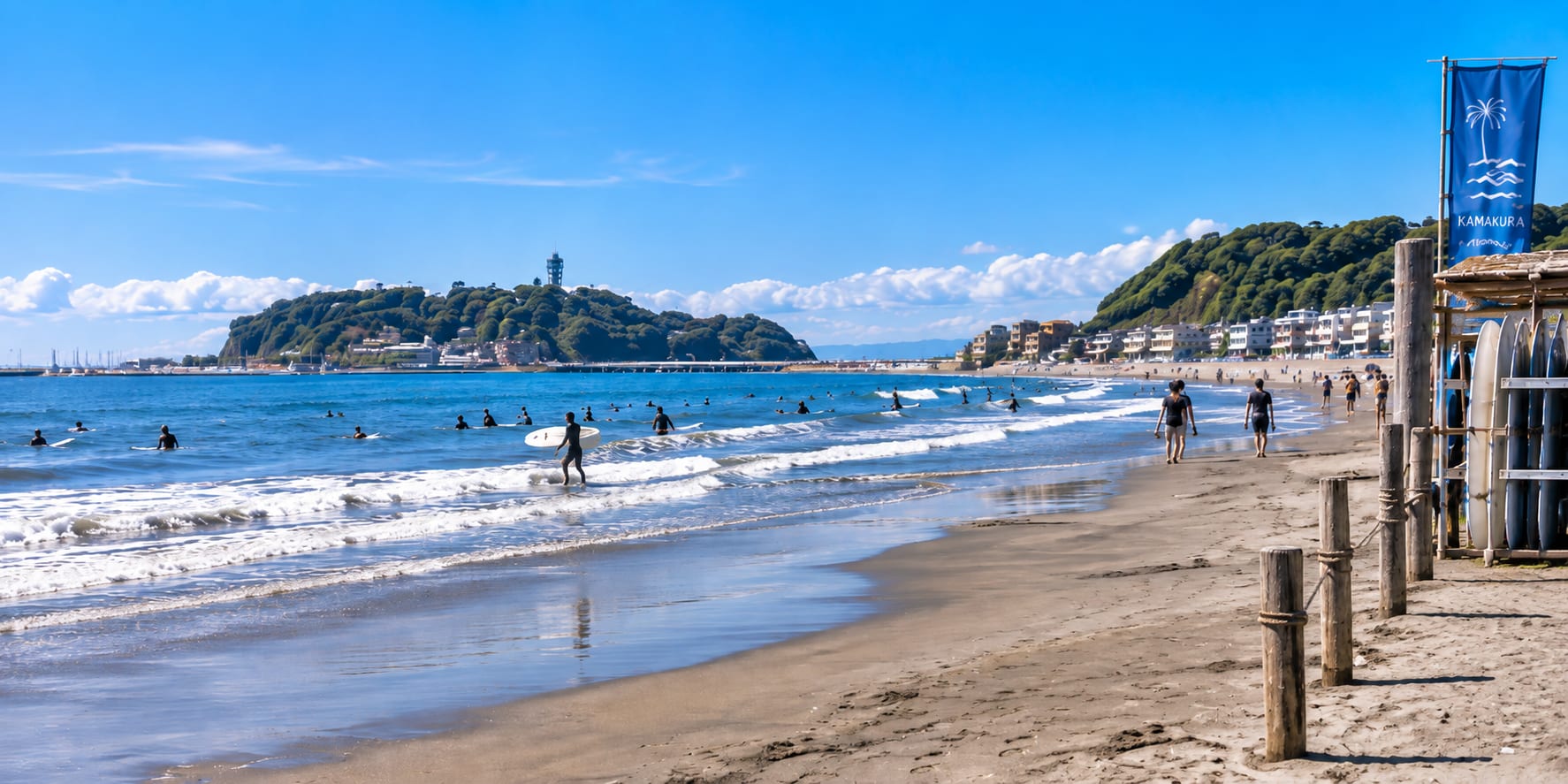
- •Yuigahama Beach (Approx. 15-30 minutes walk or short Enoden ride): Kamakura's main public beach, a free, year-round stretch of shoreline near Hasedera and the Great Buddha, with a summer swimming season and strong autumn-winter sunset value.
- •Kamakura Hase Station Area (Approx. 10 minutes walk): A charming neighborhood filled with traditional shops, cafés, local restaurants, and small boutiques that showcase Kamakura's relaxed coastal character.
- •Tsurugaoka Hachimangu Shrine (Approx. 15 minutes by Enoden and walk): Kamakura's most important Shinto shrine, a hilltop complex reached by a long cherry tree lined approach and the historical center of the Kamakura shogunate.
- •Enoshima Island (Approx. 25 minutes by Enoden): A small island in Fujisawa, a short Enoden ride from Kamakura, known for Enoshima Shrine, the Sea Candle observation tower, sea caves, and fresh shirasu seafood.
Suggested Itinerary
Pair Great Buddha of Kamakura (Kotoku-in) with these nearby stops for a full day in Hase, Kamakura.
Frequently Asked Questions
Planning Your Kamakura Trip?
See the full Kamakura destination guide or browse Japan itineraries that include this city.
See all Temples & Shrines across Japan →Explore all attractions in Kamakura or browse nearby destinations.
Back to Kamakura Guide →