Tenryu-ji Temple
ExploreJapanDaily Editorial Team · Last updated: September 28, 2026
Tenryu-ji is the Zen temple at the heart of Arashiyama, known for the Sogenchi pond garden laid out by its founding abbot about 700 years ago. It is open 8:30 a.m. to 5:00 p.m. every day, and the garden costs ¥500; its north gate opens onto the Arashiyama Bamboo Grove. The ceiling dragon in the Dharma Hall is a separate ¥500 ticket, shown mainly on weekends and holidays.

- Area
- Arashiyama
- Best For
- Zen Gardens, UNESCO Heritage, History, Shojin Ryori
Visiting Tenryu-ji Temple
Tenryu-ji was founded in 1339 by the shogun Ashikaga Takauji in memory of Emperor Go-Daigo, with the Zen master Muso Soseki as its first abbot. Eight major fires have destroyed its buildings over the centuries; most of what stands today dates from the late 19th and early 20th centuries.
The garden is the exception. Muso Soseki laid out the Sogenchi pond garden nearly seven hundred years ago, and the temple says it keeps its original appearance; it was the first garden in Japan designated a Site of Special Historic and Scenic Importance. It is a strolling garden around a pond, best seen from the veranda of the Hojo, facing a group of standing rocks that represent the Dragon Gate Falls.

The temple's north gate, beyond the Hyakka-en flower garden, opens onto the path through the Arashiyama Bamboo Grove. The route below uses it.
The route through Tenryu-ji
Short answer
Enter from the main street, see the Cloud Dragon in the Dharma Hall if it is open, go through the Kuri to the Hojo veranda over the Sogenchi pond, walk around the pond garden, then climb through the Hyakka-en to the north gate and the bamboo grove.
Start
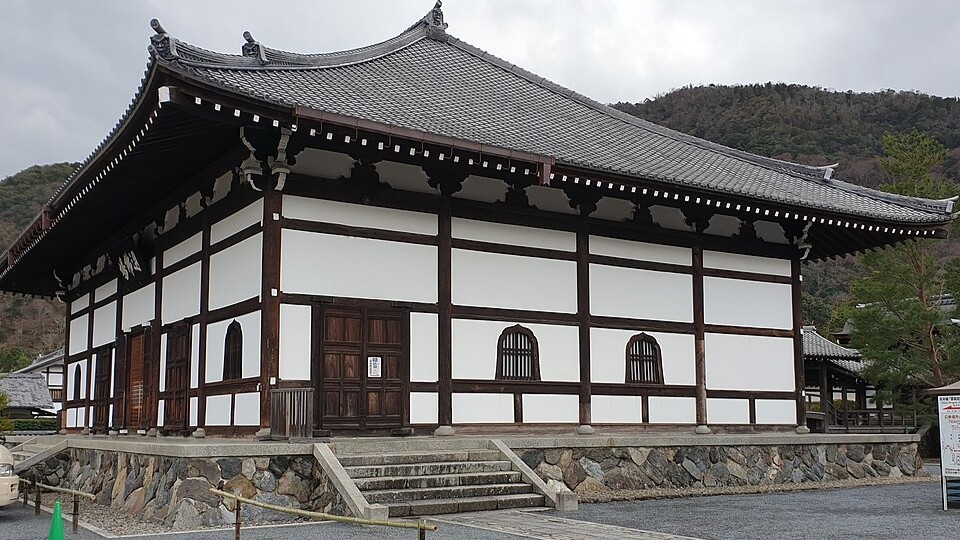
The approach and the Dharma Hall
The Dharma Hall holds the Cloud Dragon ceiling (separate ¥500, mainly weekends, holidays and special periods).
Next
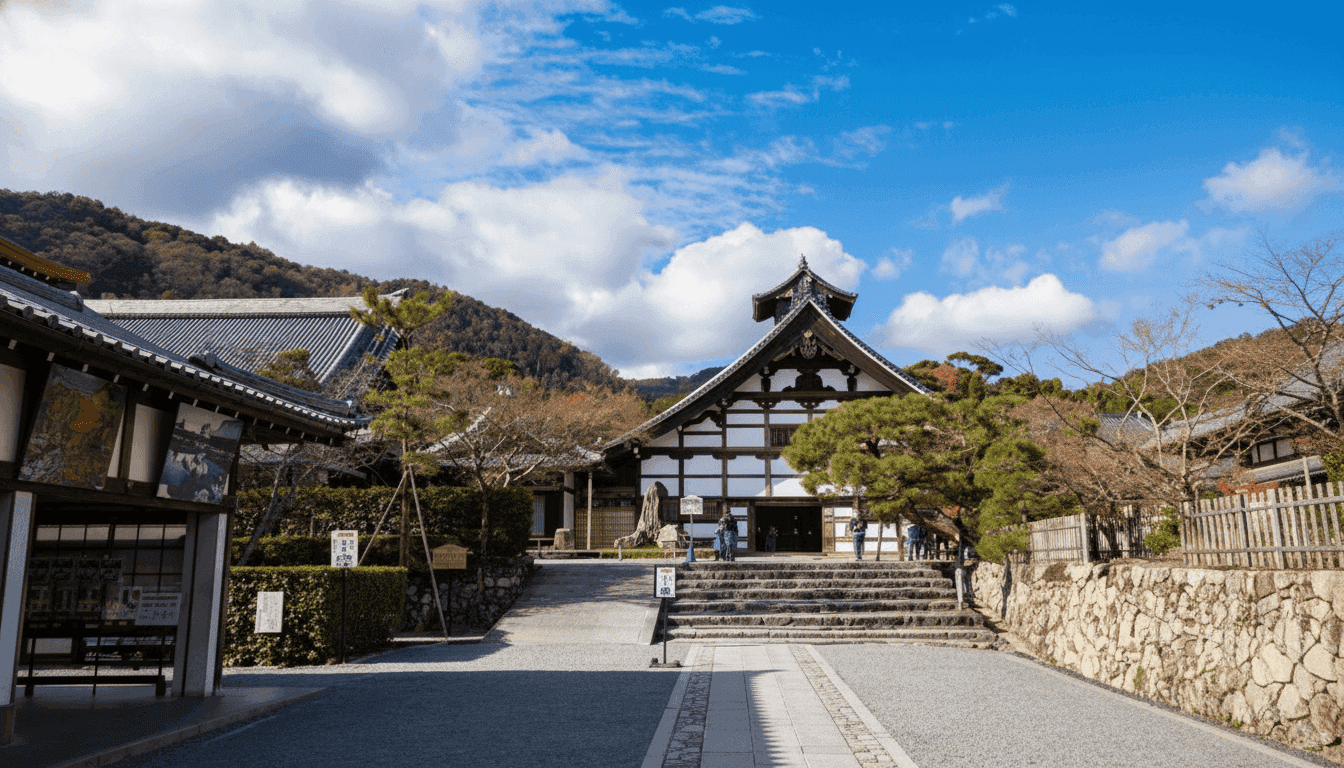
The Kuri
The kitchen and office building with the tall white gable, the temple's most photographed building, connected to the Hojo.
The center of the visit
Hojo and the Sogenchi Garden
Sit on the Hojo veranda facing the pond and the Dragon Gate Falls stones, then follow the level path around the pond.
Exit
Hyakka-en and the north gate
A flower garden climbs gently to the north gate, which opens onto the Arashiyama Bamboo Grove.

When to go
Short answer
Arrive at the 8:30 a.m. opening. To see the Cloud Dragon, come on a weekend or holiday, or during the spring and autumn special periods.
- Garden and buildings
- 8:30 a.m. to 5:00 p.m. daily, last admission 4:50 p.m.
- Cloud Dragon, spring and autumn
- Daily in the special periods; in 2026, March 1 to May 31 and September 19 to December 6, 9:00 a.m. to 4:30 p.m.
- Cloud Dragon, rest of the year
- Saturdays, Sundays and holidays; 9:00 a.m. to 1:00 p.m. in high summer, when the hall gets very hot.
Fitting Tenryu-ji into a Kyoto day
Short answer
Tenryu-ji and the bamboo grove are one walk. From Arashiyama, the JR Sagano Line runs back through Nijo, and northwest Kyoto's temples fill an afternoon.
Better on another day
Higashiyama
Kiyomizu-dera and Gion are on the opposite side of the city; keep them for another day.
Things to look for at Tenryu-ji
How to Get to Tenryu-ji Temple
Tenryu-ji is in the middle of Arashiyama, on the main street near the river. Trains are the reliable choice; the temple warns that the road in front is closed to traffic on some peak autumn afternoons.
- •Randen Arashiyama Station is 5 minutes' walk; JR Saga-Arashiyama 13 minutes.
- •The JR Sagano Line from Kyoto Station is covered by the JR Pass.
- •Leave by the north gate to continue into the bamboo grove.
Map
Best Time to Visit Tenryu-ji Temple
Best time to visit Tenryu-ji Temple: At 8:30 AM opening; weekends and holidays if you want to see the Cloud Dragon. Weekday mornings are generally quieter than weekends and public holidays.
- •At the 8:30 a.m. opening, before Arashiyama fills up.
- •On a weekend or holiday, or in the spring and autumn special periods, to see the Cloud Dragon.
- •The buildings close for some ceremonies; in 2026, on the afternoon of April 1 and on October 29 and 30.
Entry Fee & Hours
| Category | Price (JPY) | Approx. (USD) |
|---|---|---|
| High school student and older | ¥500 | ~$3.3 |
| Elementary and junior high student | ¥300 | ~$2 |
| Category | Price (JPY) | Approx. (USD) |
|---|---|---|
| Add to the garden fee | +¥300 | ~$2 |
| Category | Price (JPY) | Approx. (USD) |
|---|---|---|
| Per person | ¥500 | ~$3.3 |
- •Preschool children are free. Tickets are sold at the garden entrance, the main building entrance and the north gate.
- •The Dharma Hall fee is separate from the garden and buildings. The buildings close occasionally for ceremonies; in 2026, on the afternoon of April 1 and on October 29 and 30.
Nearby Attractions
Places that pair with Tenryu-ji

Arashiyama Bamboo Grove

Nijo Castle

Ryoan-ji Temple

Kinkaku-ji (Golden Pavilion)
- •Arashiyama Bamboo Grove (Through the temple's north gate): The Arashiyama Bamboo Grove is a short public path through tall bamboo in the Sagano area of western Kyoto, free to walk and with no gate. Most visitors combine it with Tenryu-ji's garden, Okochi Sanso and Nonomiya Shrine, which sit along it.
- •Nijo Castle (Central Kyoto, on the JR Sagano Line): Nijo Castle is a UNESCO World Heritage castle in central Kyoto, built for the Tokugawa shoguns. Its Ninomaru Palace, a National Treasure, is the only surviving example of a fortified palace complex, with wall paintings by the Kano school; the end of shogunate rule was proclaimed here in 1867.
- •Ryoan-ji Temple (Northwest Kyoto): Ryoan-ji is a Rinzai Zen temple in northwest Kyoto, founded in 1450 by Hosokawa Katsumoto and part of the Historic Monuments of Ancient Kyoto World Heritage site. Its rock garden sets 15 stones in about 248 square meters of white gravel, and no one knows who designed it.
- •Kinkaku-ji (Golden Pavilion) (Northwest Kyoto, by city bus): Kinkaku-ji, the Golden Pavilion, is a Zen temple in northwest Kyoto whose three-story relics hall has its upper two stories covered in gold leaf. Visitors see it across Kyoko-chi pond on a single walking route through the garden. The temple is a UNESCO World Heritage site.
Two ways to build a day around Tenryu-ji
Both start at the 8:30 a.m. opening and leave by the north gate.
Arashiyama morning
Temple, grove and a temple lunch.
8:30 a.m.
Tenryu-ji's garden and the Hojo veranda.
Mid-morning
North gate to the Arashiyama Bamboo Grove.
Lunch
Shigetsu, booked ahead.
West Kyoto
Arashiyama, then back through the center.
8:30 a.m.
Tenryu-ji and the bamboo grove.
Midday
JR Sagano Line to Nijo.
Afternoon
Nijo Castle, entry until 4:00 p.m.
Frequently Asked Questions
Planning Your Kyoto Trip?
See the full Kyoto destination guide or browse Japan itineraries that include this city.
See all Temples & Shrines across Japan →Explore all attractions in Kyoto or browse nearby destinations.
Back to Kyoto Guide →