NYK Hikawa Maru
By Andrew Liyan · Last updated: September 1, 2026 · Facts verified: September 1, 2026

- Area
- Naka-ku, Yokohama
- Best For
- History lovers, WWII history, Budget travelers, Maritime enthusiasts
Visiting NYK Hikawa Maru
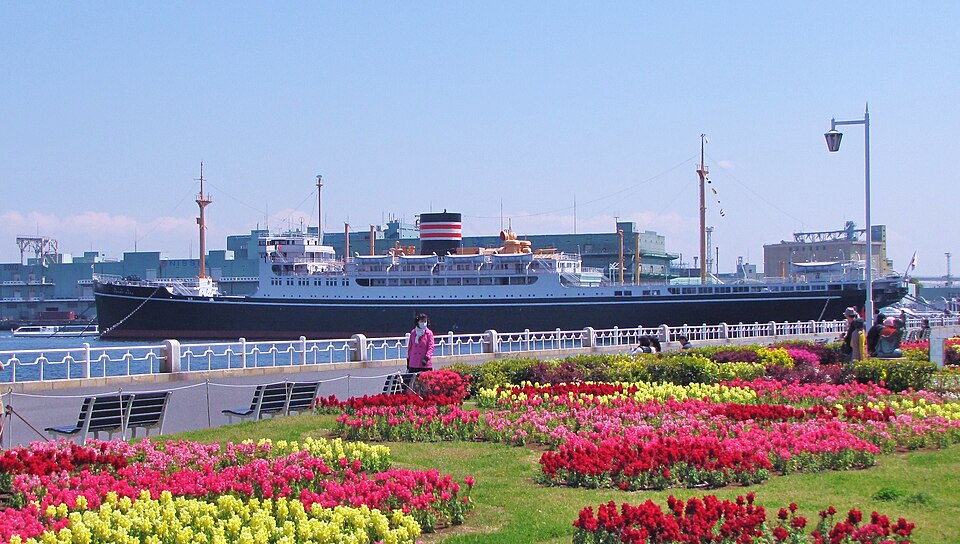
The NYK Hikawa Maru is a preserved 1930 transpacific ocean liner permanently moored beside Yamashita Park in Yokohama, Japan's last surviving pre-war-built ocean liner and a National Important Cultural Property. Unlike a replica or a themed exhibit, this is the genuine vessel that once carried passengers and cargo across the Pacific, and visitors can walk through its restored art deco first-class interiors on a low-cost, self-guided tour. It is a fundamentally different kind of preserved vessel from Nippon Maru, the sail-training ship moored elsewhere in Yokohama near Minato Mirai; Hikawa Maru's story belongs to passenger service, wartime medicine, and refugee rescue, not sail training.
Built by the Yokohama Dock Company, the ship launched on September 30, 1929, and completed its maiden voyage on May 13, 1930, sailing from Kobe to Seattle. From 1930 to 1941, it operated NYK Line's Yokohama-Vancouver-Seattle route, completing 73 pre-war Pacific voyages and carrying roughly 10,000 passengers, according to the ship's official history page.
Its passenger list over those years included some notable names. Charlie Chaplin sailed on the Hikawa Maru during his 1932 world tour, and Prince and Princess Chichibu are recorded among its guests. In 1940 and 1941, the ship also carried Jewish refugees fleeing Nazi persecution to Canada and the United States, including the family of Rabbi Zerach Warhaftig in June 1941, a history that gives the ship particular resonance for travelers researching Japan's WWII-era connections to Jewish refugee movements.
The ship's role changed entirely when Japan entered the Pacific War. On December 1, 1941, the Hikawa Maru was converted into an Imperial Japanese Navy hospital ship. It survived three separate mine strikes, in October 1942, July 1944, and February 1945, and completed 24 wartime voyages carrying over 30,000 wounded and sick soldiers. After the war ended, it continued repatriating soldiers and civilians until 1946.
Commercial passenger service resumed from 1953 to 1960, after which the ship's official history page records a lifetime total of 254 Pacific crossings and more than 25,000 passengers across its full career. The Hikawa Maru was decommissioned on December 21, 1960, and has been permanently moored beside Yamashita Park as a museum ship since 1961. On August 17, 2016, it was designated a National Important Cultural Property, recognition of its status as Japan's only surviving pre-war-built ocean liner of its kind.
Inside, a largely one-way route carries visitors from the bridge down through the first-class areas, the engine room, and an exhibition room, before finishing in a cramped third-class cabin that stands in deliberate contrast to the first-class spaces above. The Things to Do section below walks through this route deck by deck, since the interiors themselves, not just the ship's history, are the strongest reason to pay for the onboard visit rather than only photographing the ship from the park.
NYK Line, the ship's operator, convened an expert committee on ship preservation and architecture in January 2026, following hull-integrity surveys conducted since 2024, to set technical and conservation policies ahead of possible large-scale repairs to the ship. As of this page's fact-verification date, no visitor-access closure has been announced and the ship continues to operate on its normal hours; this is worth knowing as background rather than a reason for concern, and travelers with an upcoming visit should check the ship's official hours page for the latest status.
Admission is genuinely inexpensive relative to most other paid attractions in the Yokohama waterfront cluster: adult tickets start at ¥300, roughly $2 USD, making the ship one of the lowest-risk paid stops to add to a Yamashita Park day even for travelers who are only mildly curious. Payment is cash only at the reception window, with no advance reservation needed.
Because the ship sits directly at Yamashita Park's edge, a Hikawa Maru visit fits naturally before or after a walk along the park's waterfront promenade, and Yokohama Chinatown is a short walk beyond that. The sections below cover what the deck-by-deck route actually shows, current hours and admission, how long to allow, and how to decide whether the paid interior visit is worth it for your particular trip.
Things to Do at NYK Hikawa Maru
The visitor route begins on the bridge level, where the wheelhouse, the ship's hydraulic steering-gear control device, and the surrounding deck give a sense of how the Hikawa Maru was actually sailed. The captain's office sits directly below the bridge, positioned there deliberately so the captain could respond quickly to any situation on deck.
How to Get to NYK Hikawa Maru
NYK Hikawa Maru is permanently moored beside Yamashita Park in Naka-ku, in the heart of Yokohama's historic harbor district, within walking distance of Yokohama Chinatown.
From Motomachi-Chukagai Station (Primary Route)
Motomachi-Chukagai Station on the Minatomirai Line is the closest station to the ship. Exit 4 puts you approximately a 3-minute walk from the ship's reception entrance, at the edge of Yamashita Park.
From Ishikawacho Station (JR Negishi Line)
Ishikawacho Station on the JR Negishi Line is a useful alternative for travelers building a JR-based itinerary, since the Minatomirai Line is a separate private line. From Ishikawacho, the ship is approximately a 15-minute walk through the Yamashita-cho area.
From Yokohama Station
The Minatomirai Line runs directly from Yokohama Station to Motomachi-Chukagai Station, its final stop, without needing to change trains.
From Tokyo Station
Take a JR line, the Tokaido Line, Yokosuka Line, or Keihin-Tohoku Line, to Yokohama Station, then transfer to the Minatomirai Line and ride it to Motomachi-Chukagai Station.
From Haneda Airport
Take the Keikyu Line to Yokohama Station, then transfer to the Minatomirai Line and continue to Motomachi-Chukagai Station.
By Bus or Sea Bus
Bus stops near Yamashita Koen-mae serve the park and the ship directly, and a Sea Bus commuter-boat stop at Yamashita Koen offers a scenic alternative for travelers already near the waterfront.
By Taxi
Taxis are available at Yokohama Station and can reach the ship via the waterfront roads around Yamashita Park. There is no on-site parking at the ship itself; nearby paid lots are the only option for travelers arriving by car.
Walking From Yamashita Park or Chinatown
If you are already in Yamashita Park, the ship is right at the park's edge and needs no further travel. From Yokohama Chinatown, it is an easy walk of just a few minutes.
Best Time to Visit
A weekday visit avoids the Monday closure and any national-holiday shift in that closure day. There is no distinct evening experience here, since the ship closes at 5:00 PM, so plan a Hikawa Maru visit for daytime hours, either before or after a walk through Yamashita Park.
Best Time to Visit NYK Hikawa Maru
Weekdays, to avoid the Monday closure; pairs naturally with a Yamashita Park walk before or after.
Entry Fee & Hours
| Category | Price (JPY) | Approx. (USD) |
|---|---|---|
| Adult / college student | ¥300 | ~$2 |
| Senior (65+) | ¥200 | ~$1.50 |
| Junior high / senior high school student | ¥100 | ~$1 |
| Elementary school student | ¥100 | ~$1 |
| Visitor with disability documentation, plus one companion | Free | Free |
Cash payment only at the reception window; no official online ticketing was found on the operator's site. USD amounts are approximate and change with the exchange rate.
- •Payment is cash only at the reception window. Entry is walk-in, with no advance reservation required or available on the official site.
- •The ship has no elevators, by design, to preserve its original appearance as a cultural-property structure. The areas accessible by wheelchair are very limited, and boarding and disembarking access can vary with the tide. Two diaper-changing tables are available, and advance consultation with the ship, along with a companion, is recommended for visitors who need mobility assistance.
- •Some independent sources mention a combined ticket covering both Hikawa Maru and the nearby, separately operated NYK Maritime Museum. This was not confirmed on the official Hikawa Maru ticketing page during research, so it is not stated here as a fixed price; if a combo ticket interests you, confirm directly with the reception window or the NYK Maritime Museum before your visit.
Nearby Attractions
Combine with NYK Hikawa Maru on the same day
Yamashita Park

Yokohama Chinatown

Yokohama Marine Tower

Osanbashi Pier
Frequently Asked Questions
Planning Your Yokohama Trip?
See the full Yokohama destination guide or browse Japan itineraries that include this city.
See all Museums across Japan →