Fushimi Inari Taisha
ExploreJapanDaily Editorial Team · Last updated: September 27, 2026
Fushimi Inari Taisha is free, always open and two stops from Kyoto Station, so the real planning question is how far up Mount Inari to climb. The famous torii tunnels start right behind the main shrine, many visitors turn back at the Yotsutsuji viewpoint about halfway up, and only the full loop over the summit takes 2 to 3 hours.

- Area
- Fushimi
- Best For
- Photography, Hiking, Spiritual Experiences, Early Morning Visits
- Nearby
- Uji · Toji Temple
Visiting Fushimi Inari Taisha
Fushimi Inari Taisha is the head shrine of Japan's roughly 30,000 Inari shrines. It was founded in 711 and is dedicated to Inari Okami, the deity people pray to for good harvests and business prosperity. The whole of Mount Inari, a 233-meter peak at the southern end of Kyoto's Higashiyama hills, counts as the shrine's precinct.

What draws most visitors are the torii. Worshippers and businesses have donated gates here since the Edo period, and the shrine counts around 10,000 of them along the mountain paths. Each gate carries its donor's name and dedication date, so the tunnels double as a record of centuries of offerings.
A visit is a walk uphill from the main shrine: first through the dense Senbon Torii tunnels, then through forest past smaller shrines, stone foxes and more than 10,000 stone altars left by worshippers. Foxes are Inari's messengers, which is why they appear all over the mountain. How far you go is the one real planning decision, and the route below sets out where to stop.
How far up Mount Inari to go
Short answer
You do not need to reach the summit to see the famous gates. The densest torii tunnels, Senbon Torii, start just behind the main shrine. The Yotsutsuji intersection, roughly halfway up with a view over southern Kyoto, is where many visitors turn back. Continue to the summit loop only if you want 2 to 3 hours of stairs and quieter forest shrines.
Start
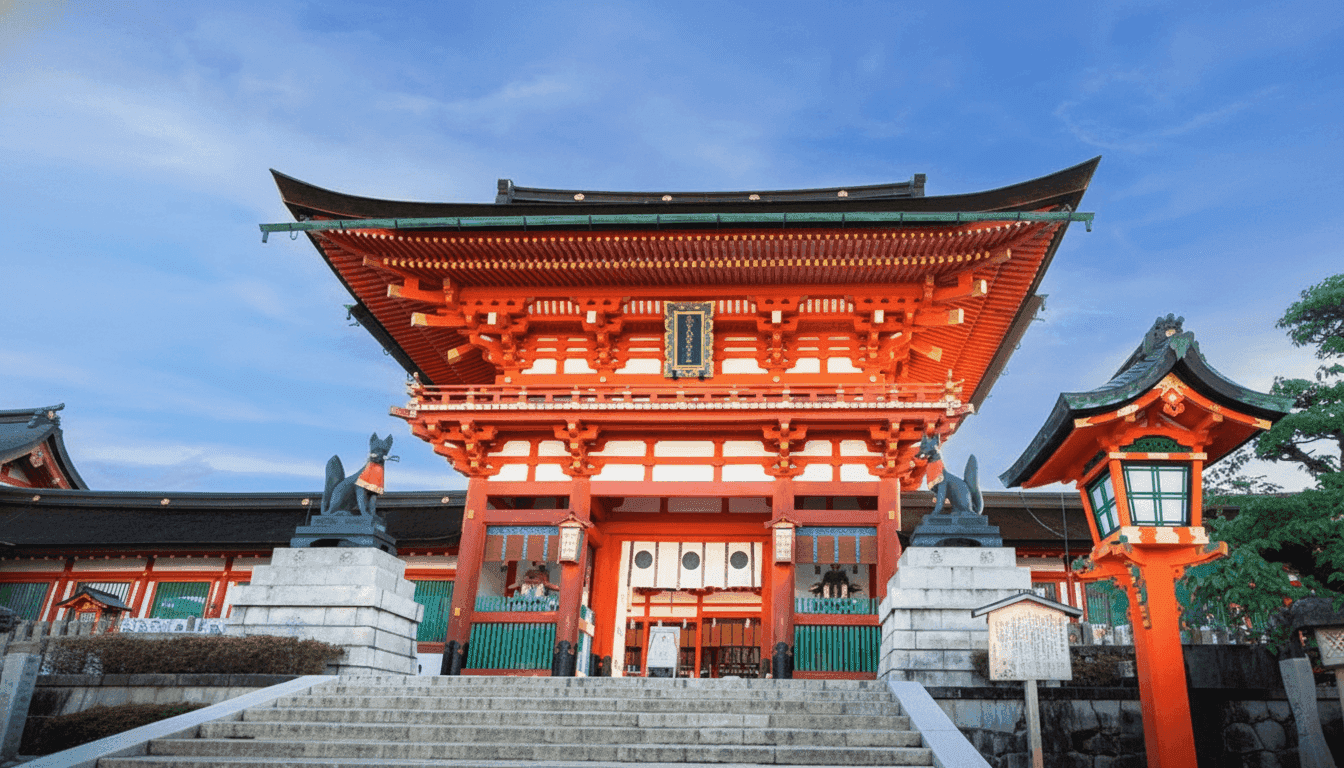
Romon Gate and the main hall
The walk begins at the gate and the main hall, an Important Cultural Property rebuilt in 1499 after the Onin War. The approach and main shrine area are the most level part of the visit.
Under 1 hour in total
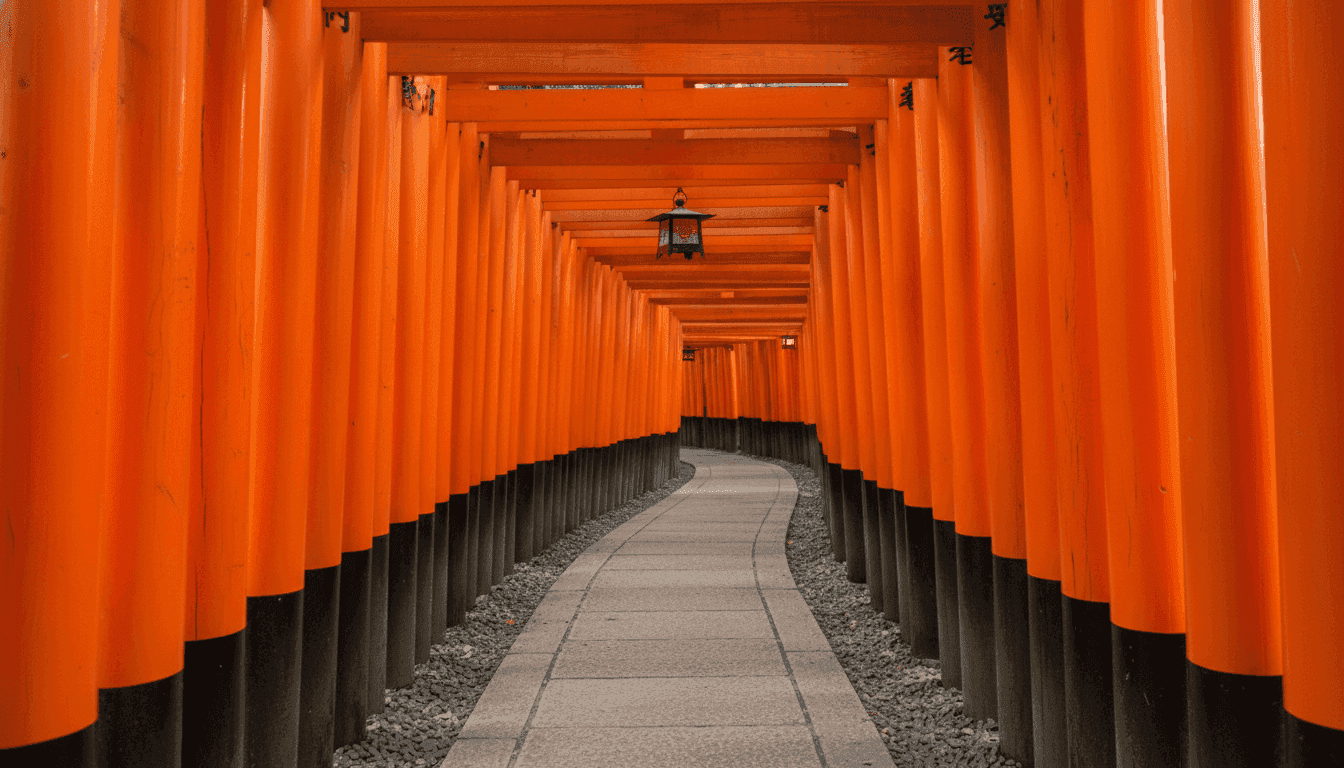
Senbon Torii to the Okusha Hohaisho
Two parallel tunnels of closely spaced gates lead to the Okusha Hohaisho prayer hall. This is the stretch in most photographs, and it is where the crowds gather.
Turn back here if you are short on time, visiting with small children, or want to avoid long flights of stairs.
1 to 1.5 hours in total (30 to 45 minutes up)
Yotsutsuji intersection
Roughly halfway up, with a view over southern Kyoto. By here you have walked through plenty of torii, well beyond the crowds of the lower tunnels. Beyond it the gates thin out.
Turn back here if the torii are what you came for. It is a natural end point, not a compromise.
2 to 3 hours in total
The summit loop
Mostly stone stairs through forest, past smaller shrines and stone altars, with fewer gates. There is a tea stall and shop about halfway up. Go on only if you want the hike itself.


When to go, and where the crowds are
Short answer
Crowds concentrate on the lower torii near the main shrine, so time of day matters most there. Arrive early in the morning if photos of empty tunnels matter to you. If you plan to climb, timing matters less: the paths get quieter the higher you go.
- Early morning
- The best chance of quiet lower tunnels and soft light. There is no gate or opening time, so you can start as early as you like.
- Late morning to afternoon
- The busiest window on the lower paths, especially in cherry blossom season, autumn and on public holidays. It is still a reasonable time for the full hike, with a stop at the tea stall and shop about halfway up.
- Evening
- Quieter than midday on the lower paths. Higher up, the paths run through forest, so climb only as far as you are comfortable on stone stairs in low light.
- Hot months
- The full loop is steady stair climbing. In summer, start early and carry water.
Fitting Fushimi Inari into a Kyoto day
Short answer
Fushimi Inari sits south of central Kyoto on two rail lines, so pair it by the line you are already on rather than by distance on a map. The suggested itineraries below turn the first two pairings into a day.
South on the JR Nara Line
Uji
Continue south to Uji for Byodo-in and matcha: Fushimi Inari in the morning, Uji in the afternoon.
North on the Keihan Main Line
Gion and Higashiyama
From Keihan Fushimi-Inari Station, ride north to Gion-Shijo for Gion and the walk up to Kiyomizu-dera.
Two JR stops north
Around Kyoto Station
Back at Kyoto Station you are close to Toji Temple and Kyoto Tower, an easy end to a short visit.
Better on another day
Arashiyama
Arashiyama is on the far side of the city and involves just as much walking, so most itineraries give it a separate half day.
For choosing between trains and buses across the city, see Getting Around Kyoto.
Shrine rules worth knowing before you go
Short answer
The whole mountain is shrine precinct, and the shrine publishes a short list of requests. The ones visitors most often break: eating while walking, blocking the narrow torii paths for photos, and flying drones.
Eating a snack while walking through the torii
Instead: Eat on the approach street or in the marked rest areas. The shrine prohibits eating and drinking elsewhere in the grounds, including while walking.
Stopping in the middle of a narrow path for photos
Instead: Step aside at a wider spot or wait for a gap. The shrine specifically asks visitors not to block others while photographing on narrow paths.
Bringing a drone or a pet
Instead: Drones are prohibited, and pets are not allowed in the grounds (guide dogs and other necessary animals excepted).
Driving to the shrine
Instead: Take the train. The shrine recommends public transport because its parking is very crowded, and the lots are for worshippers only.
Leaving a stroller unattended
Instead: Leave strollers only in the marked areas. The stairs above the lower tunnels are not suited to strollers in any case.
Things to look for at Fushimi Inari
How to Get to Fushimi Inari Taisha
Fushimi Inari Taisha is right beside JR Inari Station, two stops and about five minutes from Kyoto Station on the JR Nara Line. Keihan Fushimi-Inari Station, on the line from Gion and Osaka, is about five minutes away on foot.
There is no gate or opening time, so you can arrive as early or as late as you like.
- •JR Inari Station is beside the shrine entrance; Keihan Fushimi-Inari Station is about five minutes on foot.
- •The shrine asks visitors to use public transport: its car parks are very crowded and reserved for worshippers.
- •The JR Nara Line is a JR line, so a valid Japan Rail Pass covers the ride from Kyoto Station.
Map
Best Time to Visit Fushimi Inari Taisha
Best time to visit Fushimi Inari Taisha: Early morning, especially on weekdays. Weekday mornings are generally quieter than weekends and public holidays.
- •Time of day matters more than season here; the crowd timing section above has the detail by time of day.
- •Crowds peak at weekends, on public holidays and in Kyoto's spring and autumn high seasons.
- •In summer the full loop is hot stair climbing: start early and carry water.
Entry Fee & Hours
- •The shrine does not publish accessibility information for the mountain paths. The approach and main shrine area are the most level part of a visit; above the lower torii tunnels the paths are mostly stone stairs.
- •Strollers must not be left unattended outside the marked areas.
Nearby Attractions
Combine with Fushimi Inari Taisha on the same day

Uji
Toji Temple
Kyoto Tower

Gion District

Kiyomizu-dera Temple
- •Uji (South of Fushimi Inari on the JR Nara Line): Uji is a tea town on the Uji River south of Kyoto, with two World Heritage sites: Byodo-in, whose Phoenix Hall is on the 10-yen coin, and Ujigami Shrine, whose main hall is the oldest surviving shrine building in Japan.
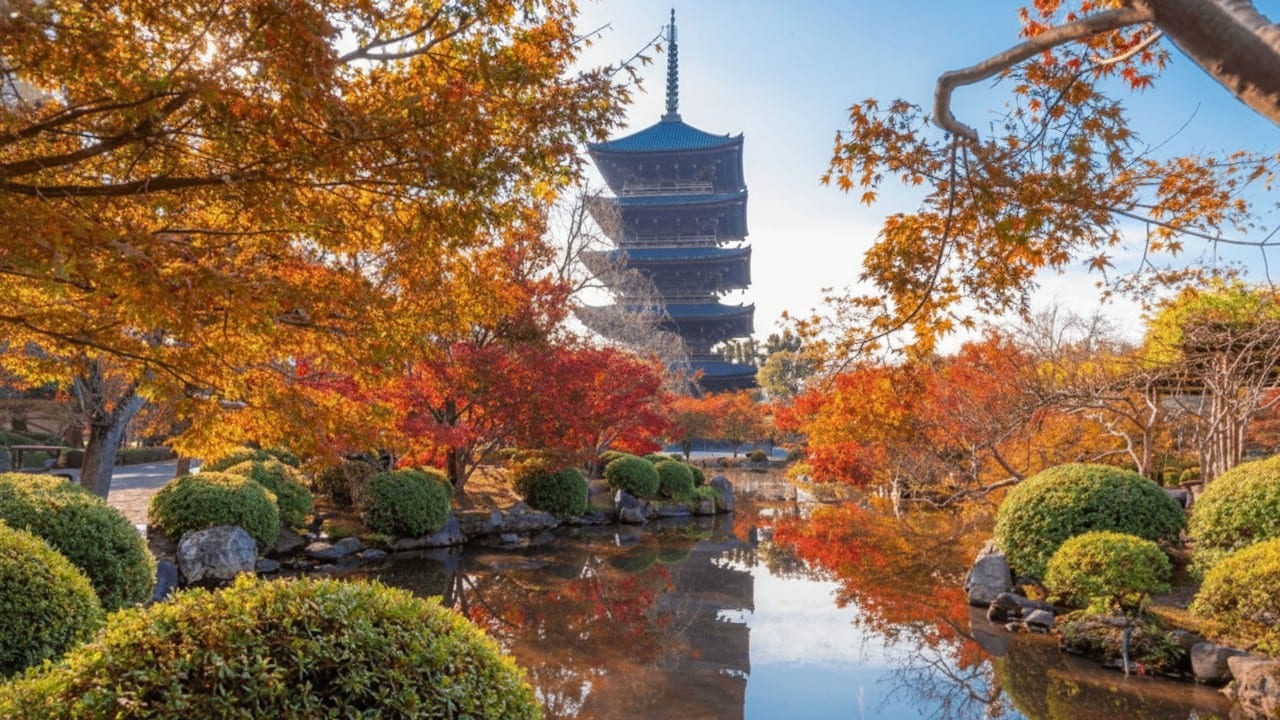
- •Toji Temple (Near Kyoto Station, two JR stops north): Toji (Kyo-o-gokoku-ji) was founded in 796 as one of two great temples guarding the southern gate of the new capital, and was given to the monk Kukai in 823. It is the head temple of Shingon Buddhism, part of the Historic Monuments of Ancient Kyoto World Heritage site, and its pagoda, rebuilt in 1644, is the tallest five-story pagoda in Japan.
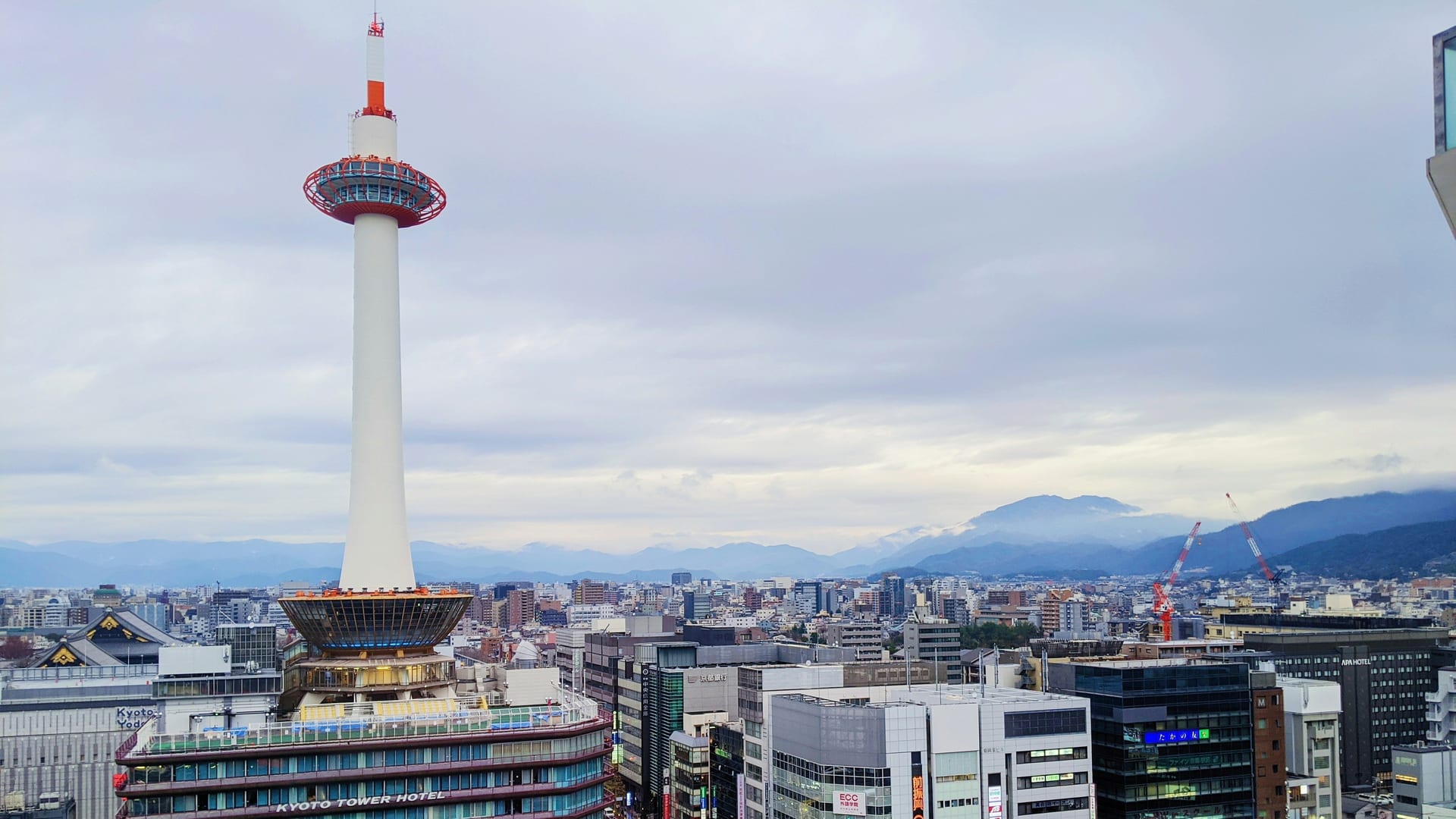
- •Kyoto Tower (Opposite Kyoto Station, two JR stops (about 5 minutes) north): Kyoto Tower is the 131-meter tower opposite Kyoto Station, with an observation deck 100 meters up that looks across the whole city basin, and a food hall, souvenir shops and workshops in the building below.
- •Gion District (North on the Keihan Main Line to Gion-Shijo): Gion is the historic geiko district of Kyoto, east of the Kamo River around Hanamikoji-dori and the Shirakawa canal, next to Yasaka Shrine. Its streets of wooden teahouses are free to walk, while the private lanes off Hanamikoji are signposted no entry for sightseers.
- •Kiyomizu-dera Temple (Keihan Main Line to Gion-Shijo, then the walk up through Higashiyama): Kiyomizu-dera is a Buddhist temple on the slopes of Mt. Otowa in eastern Kyoto, founded in 778. Its Main Hall stands on a wooden stage held up by 18 zelkova pillars, with a view across the city. The temple is a UNESCO World Heritage site.
Two ways to build a day around Fushimi Inari
Both start early at the shrine, while the lower tunnels are quiet, and differ only in which line you take next.
Shrine, then Uji
The calmer day: one rail line, south all the way.
Early morning
Walk the Senbon Torii before the crowds, then climb to Yotsutsuji for the view (1 to 1.5 hours in total).
Late morning
Inari-zushi on the approach street, eaten there rather than on the trail.
Afternoon
JR Nara Line south to Uji for Byodo-in and matcha.
Shrine, then Gion and Higashiyama
The fuller day, with the busiest part of the city in the afternoon.
Early morning
The Senbon Torii and Okusha Hohaisho (under 1 hour), or on to Yotsutsuji if you started early.
Midday
Keihan Main Line north from Fushimi-Inari to Gion-Shijo.
Afternoon
Walk up through Higashiyama to Kiyomizu-dera.
Evening
Gion after dark.
Frequently Asked Questions
References
View references
Fushimi Inari Taisha
Japan National Tourism Organization
Keihan Electric Railway
JAPAN RAIL PASS
Planning Your Kyoto Trip?
See the full Kyoto destination guide or browse Japan itineraries that include this city.
See all Temples & Shrines across Japan →Explore all attractions in Kyoto or browse nearby destinations.
Back to Kyoto Guide →