Japan Etiquette Guide
What to know before you go, so you can travel with confidence instead of anxiety about getting it wrong.
You don't need to be perfect. Japan's etiquette norms are more forgiving of visitors than reputation suggests, showing respect, watching what people around you are doing, and staying considerate matter far more than memorizing every rule in this guide. A handful of habits make the biggest difference: never tip, remove your shoes where you see a step-up entryway, keep your voice down on trains, and wash before you soak at an onsen. Everything else here is context, not a test.
What's the most important etiquette rule in Japan? Be quiet and considerate in shared spaces, on trains, in queues, and in public generally. Almost every other custom in this guide is a variation on that single idea.
Why Etiquette Matters in Japan
The values behind the customs, not just the rules themselves
Consideration for others
Most Japanese etiquette boils down to one idea: don't make your presence a burden on the people around you, whether that's a quiet train car or a shared bath.
Harmony (wa)
Wa is the cultural preference for group smoothness over individual convenience. It's why people queue patiently, lower their voices in public, and rarely make a scene.
Cleanliness
Public spaces, trains, and streets stay remarkably clean partly because people carry out their own trash and take pride in shared surroundings.
Quiet public spaces
Silence on trains and in many public areas isn't coldness, it's a shared agreement that everyone deserves a calm commute or a peaceful walk.
Queueing and order
Lines form naturally, even without staff managing them, for trains, elevators, and popular restaurants. Cutting a queue reads as one of the ruder things a visitor can do.
You're not expected to know it all
Locals generally extend visitors a lot of grace. Genuine effort and a polite attitude matter far more than flawless execution of every custom.
Public Etiquette
The everyday habits that shape how you're perceived on the street
Keep your voice down
Loud conversation, especially in a foreign language, carries and draws attention. A quieter volume than feels natural at home blends in better almost everywhere.
Queue for everything
Trains, elevators, popular ramen counters, even taxi stands: if there's a line, join the back of it rather than sidling up to the front.
Mind personal space and sidewalks
Stopping suddenly to check a phone or take a photo in the middle of a busy sidewalk blocks foot traffic. Step to the side first.
Stand single-file on escalators
Tokyo keeps to the left, Osaka to the right, leaving the other side clear for people walking up. When in doubt, watch what locals around you are doing.
Save eating for a seat
Eating while walking is uncommon outside food festivals and specific street-food areas like Dotonbori or Tsukiji Outer Market. Step aside and finish before moving on.
Step aside for phone calls
Talking on the phone in a restaurant, train, or waiting room is considered disruptive. Take the call outside or in a designated area.
Keep affection low-key
Holding hands is fine; kissing or embracing in public draws stares in most settings. It's a modesty norm, not a judgment on you personally.
Smoke only in designated areas
Smoking while walking is banned in many city wards and enforced with fines. Look for designated smoking areas, often glass-walled booths near stations.
Train & Public Transport Etiquette
Where quiet, orderly behavior matters most
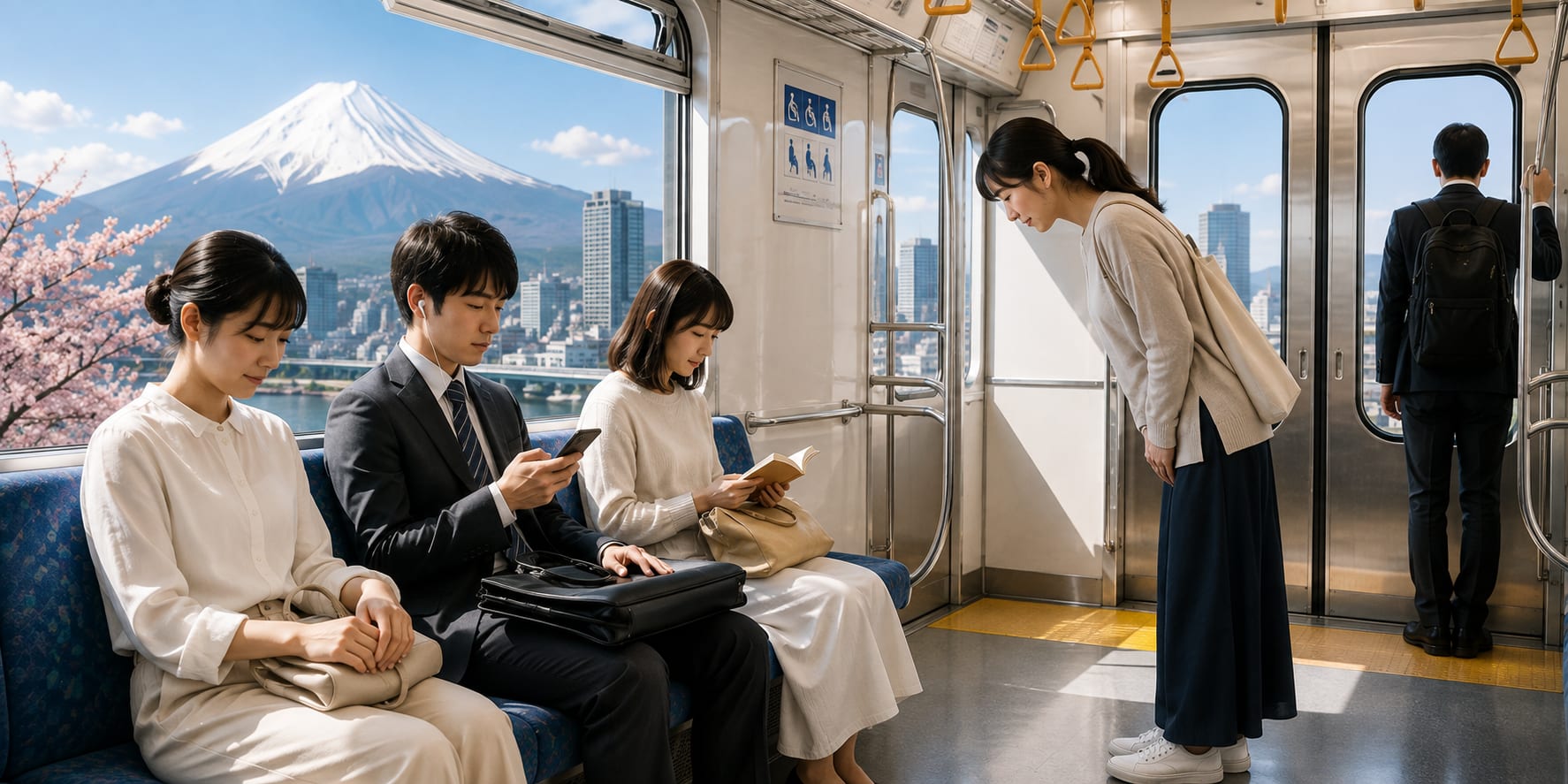
Keep conversations quiet
A calm, library-level volume is the norm on trains and platforms. Groups naturally lower their voices once aboard.
Set your phone to silent
Phones go into "manner mode" the moment you board. Calls are avoided entirely on commuter trains, even brief ones.
Offer priority seats
Priority seating (yusenzaseki) near train doors is reserved for elderly, pregnant, injured, or disabled passengers. Give it up without being asked if someone who needs it boards.
Wear your backpack on your front
On crowded trains, swing your backpack to your front or hold it between your feet so it doesn't bump other passengers.
Store large luggage properly
On the shinkansen, oversized luggage needs a reserved seat with a rear luggage space (booked in advance) or goes in the overhead rack if it fits. On local trains, keep bags out of the aisle.
Let passengers off before boarding
Stand to the side of the doors and let everyone exit first. Pushing straight on as the doors open is one of the more visible etiquette misses tourists make.
Save meals for the shinkansen
Eating a full meal is normal and expected on long-distance trains like the shinkansen, that's what the ekiben (station bento) culture is built around, but not on local commuter lines.
Restaurant Etiquette
From walking in the door to paying the bill
Wait to be seated
Most restaurants, even casual ones, seat you rather than let you choose a table. Wait near the entrance until staff greet you, unless it's clearly self-seating counter service.
Use the oshibori for your hands only
The wet towel (oshibori) handed to you at the start of a meal is for wiping your hands, not your face or the table.
Pay at the register, not the table
Most restaurants expect you to bring your bill to a register near the exit rather than paying your server at the table.
Don't expect itemized splitting
Splitting a bill item by item is uncommon and can slow down a busy register. Groups usually divide the total evenly, or one person pays and is reimbursed later.
Skip the tip
Tipping isn't practiced and can genuinely confuse staff, some will chase you down to return "forgotten" money. Excellent service is already the expected standard, reflected in the price.
Say itadakimasu and gochisousama
Saying "itadakimasu" ("I gratefully receive") before eating and "gochisousama" ("thank you for the meal") after are small, optional phrases that are consistently well received.
Chopstick Etiquette: Do vs. Avoid
| Do | Avoid |
|---|---|
| Rest chopsticks on the hashioki (chopstick rest) or laid across your bowl when not in use | Sticking them upright in a bowl of rice, which resembles a funeral incense ritual |
| Use the opposite, unused end to take food from a shared plate if no serving utensil is provided | Passing food directly from your chopsticks to someone else's, another funeral-associated gesture |
| Set chopsticks down neatly on the rest between bites | Pointing at people, gesturing, or waving chopsticks around while talking |
| Slurp noodles freely, it's normal and even signals enjoyment | Assuming table noise is universally rude, ramen and soba are the exception |
Temple & Shrine Etiquette
Sacred spaces that welcome visitors, with a few customs worth knowing
Purify at the temizuya fountain
Before approaching the main hall, rinse your left hand, then your right, then your mouth (pouring water into your hand, not drinking from the ladle) using the water pavilion near the entrance.
Follow the shrine ritual: bow, clap, pray
At Shinto shrines, the standard order is: toss a coin into the offering box, bow twice, clap twice, pray silently, then bow once more. Buddhist temples skip the clapping, a single bow with hands together is appropriate instead.
Walk to the side of the torii gate
The center of the path beneath a torii gate is traditionally considered the path of the gods. Walking slightly to one side, and offering a small bow when passing through, is a respectful habit.
Don't overthink the donation
Any small coin works for the offering box, five-yen coins are considered lucky, but the gesture matters more than the amount.
Photograph respectfully
Photography is often welcome in outdoor courtyards but restricted inside main halls or in front of certain altars. Look for posted signs, and avoid flash near paintings or statues regardless.
Dress modestly
There's no strict dress code for most temples and shrines, but modest clothing is appreciated, and some inner halls at more formal sites ask visitors to remove hats.
Kyoto is home to some of Japan's most iconic temples and shrines, from Fushimi Inari's torii gate tunnels to Kiyomizu-dera's wooden stage, and is a good place to see these customs practiced at scale.
Onsen Etiquette
A high-level overview of hot spring bathing customs
Wash and rinse before soaking
Shower thoroughly at the washing stations, seated on the small stool provided, before ever entering the communal bath. The bathwater is for soaking, not washing.
Keep your modesty towel out of the water
The small towel most onsen provide is for modesty walking around, not for bathing in. Set it aside on the edge of the bath or fold it on your head.
No swimsuits in traditional baths
Bathing is nude and separated by gender at most traditional onsen. It feels unusual at first for many visitors, but it's the norm and no one pays much attention.
Check tattoo policies ahead
Some traditional onsen still restrict visible tattoos, though this is loosening steadily. Search for "tattoo-friendly onsen" in advance, or book a private family bath (kashikiri), which sidesteps the issue entirely.
Keep the bath area quiet
Onsen are meant to be relaxing. Conversation happens, but at a low volume, and phones generally stay outside the bathing area altogether.
Hakone is one of Japan's best-known onsen towns and a popular day trip or overnight stop from Tokyo, with everything from traditional ryokan baths to open-air mountain views built into the experience.
Ryokan Etiquette
Traditional inn customs, from the genkan to the futon
Shoes off at the genkan
The step-up entryway (genkan) is where shoes come off, no exceptions. Indoor slippers are usually waiting just past it.
Switch slippers for the bathroom
Separate toilet slippers wait just inside bathroom doors. Swap into them, and don't forget to swap back out before walking through the rest of the room.
Wear your yukata left over right
The provided robe (yukata) always wraps left side over right. Right over left is reserved for dressing the deceased, so this one is worth getting right.
Meals arrive on a schedule
Kaiseki dinners and breakfasts are typically served at set times, either in your room or a dining hall, as part of the stay. Confirm timing at check-in so you're not caught out mid-outing.
Futons appear while you're at dinner
Staff typically lay out futons on the tatami while guests are at dinner, then clear them away again the next morning. There's no need to do this yourself.
Bathe before you use the ryokan's onsen
The same wash-before-soak rule from public onsen applies to a ryokan's private or shared bathing facilities.
Hotel Etiquette
Modern hotels expect fewer customs, but a few still apply
Keep noise down after dark
Hotel walls and corridors carry sound more than many visitors expect. Keep hallway conversations and TV volume low in the evening.
Leave the room reasonably tidy
You don't need to make the bed, but stacking used towels and tidying obvious clutter is appreciated, particularly at smaller, family-run properties.
Sort your trash before you leave
Many Japanese hotel rooms provide separate bins for burnable and non-burnable waste. Sorting roughly by type, rather than bagging everything together, is a small courtesy that helps housekeeping.
Respect shared facilities and hours
Shared baths, lounges, and laundry rooms usually have posted hours and etiquette (such as no laundry after 10pm). Check the signage rather than assuming 24-hour access.
Shopping Etiquette
From handling merchandise to tax-free paperwork
Ask before handling delicate items
In smaller boutiques and craft shops, it's polite to ask before picking up breakable or expensive items rather than handling them freely.
Use the tray, not your hand, to pay
Most registers have a small tray for cash or cards. Place your payment there rather than handing it directly to the cashier, it's the standard exchange method nationwide.
Queue at the register, not around it
Popular shops, especially for limited-edition or seasonal items, form orderly lines. Join the back rather than clustering near the counter.
Bring your passport for tax-free purchases
Many stores waive consumption tax for tourists on same-day purchases over a minimum amount, shown on-screen at checkout, with your passport presented at the register.
Budget for omiyage
Bringing back individually wrapped local snacks (omiyage) for coworkers or family is a deeply ingrained custom. Department store basements and train stations sell boxes specifically for this.
Photography Etiquette
Capture the trip without crossing a line
Ask before photographing private property
Traditional homes, shop interiors, and private gardens are not automatically fair game just because they look photogenic. A quick gesture asking permission goes a long way.
Don't block paths for the shot
Popular spots like Kyoto's Fushimi Inari or Arashiyama's bamboo grove get crowded. Take your photo, then step aside so others behind you aren't stuck waiting.
Turn off flash where it's restricted
Flash photography is often prohibited around artwork, altars, or delicate textiles, both to protect the object and out of respect for the space.
Never chase a geisha or maiko for a photo
In Kyoto's Gion district in particular, grabbing, blocking, or chasing geisha and maiko for photos is not just rude, it's been fined by the city. Photograph from a respectful distance, or not at all if they decline.
Check for no-photography signs at temples
Some halls, particularly those housing important statues or paintings, prohibit photography entirely. Look for posted signs before raising your camera.
Ask before photographing people directly
A candid street-style photo that clearly includes a stranger's face is best done with a quick, friendly ask first, especially for children.
Trash & Recycling
Why bins are scarce, and what to do about it
Public trash cans are genuinely rare
Since a 1995 subway attack, public bins have been largely removed from stations and streets. Don't expect to find one just because you're in a busy area.
Carry a small bag for your own rubbish
A spare plastic or cloth bag in your daypack solves most of the problem, carry your trash until you reach a convenience store, station, or your hotel.
Sort into burnable, non-burnable, and recyclables
Where bins do exist, they're usually split into categories like burnable (moyasu), non-burnable, PET bottles, and cans. Read the labels rather than guessing, locals take this seriously.
Convenience stores accept what you bought there
Konbini (convenience stores) typically have bins for bottles, cans, and food packaging purchased from that store, a reliable place to offload trash while out.
Shoes & Indoor Customs
Where shoes come off, and where slippers take over
Homes always mean shoes off
Even a brief visit to a Japanese home means removing shoes at the genkan. Guest slippers are usually offered immediately after.
Ryokans and many restaurants too
Traditional inns and restaurants with tatami seating expect the same, look for a shoe rack or a step-up entryway as the visual cue.
Tatami rooms are always shoe-free
Any room with tatami mat flooring, whether in a temple, ryokan, or home, is a shoes-off zone, no exceptions.
Dressing rooms may ask for a face cover or socks
Some clothing stores provide a thin face cover for trying on tops, or ask that socks stay on when trying on shoes, to keep merchandise resalable.
Never wear toilet slippers past the bathroom door
Separate slippers waiting just inside a bathroom are strictly for that room. Forgetting to swap back is one of the most common, and most quickly self-corrected, mistakes visitors make.
Common Tourist Mistakes in Japan
The etiquette slips that come up most often, and why they stand out
Talking loudly in public
Volume that feels normal back home often reads as loud in Japan, particularly on trains and in quiet restaurants.
Blocking sidewalks or paths
Stopping abruptly for a photo or a phone check in a busy walkway is one of the most common friction points between tourists and locals.
Ignoring queues
Cutting a line, even accidentally, at a train platform, ramen counter, or shop register stands out immediately.
Entering with shoes on
Missing a shoes-off cue, like a genkan step-up or a shoe rack at the entrance, is an easy and understandable slip, but one worth watching for.
Pointing or gesturing with chopsticks
Waving chopsticks while talking, or sticking them upright in rice, are the two chopstick habits most likely to draw a second glance.
Not carrying your own rubbish
Assuming a public bin will appear eventually often ends with trash stuffed awkwardly into a bag for hours, plan for it instead.
Running late to reservations
Punctuality is taken seriously, for restaurant bookings, tours, and especially trains, which depart on the minute printed on the schedule.
Touching cultural or religious objects
Statues, altars, and ceremonial objects at temples and shrines are generally look-don't-touch, even when there's no barrier or sign.
If You Make a Mistake
You will get something wrong at some point, and that's completely normal. A sincere apology and a polite attitude go a long way, a small bow and a quick "sumimasen" (excuse me/sorry) covers nearly every situation. Visitors are not expected to know every custom in this guide, and locals generally recognize genuine effort even when the execution isn't perfect. Nobody who visits Japan and tries to be considerate leaves having ruined a trip over a chopstick slip or a missed queue.
Etiquette Tips by Traveler Type
A few things worth knowing depending on how you're traveling
Families
Kids get plenty of leeway for noise and energy, Japan is generally warm toward traveling families. The main habits to model are quiet trains and shoes-off routines, which children pick up quickly by watching you.
Solo travelers
Solo dining at counters and small ramen shops is completely normal and comfortable, no one will think it's unusual. The main etiquette focus is simply queueing and quiet in shared spaces, since you're navigating them alone.
Business travelers
Business card exchanges (meishi) follow their own small ritual: offer and receive with both hands, take a moment to look at the card before putting it away. Punctuality and modest dress matter more here than in casual tourist settings.
Luxury travelers
Ryokan and fine-dining etiquette (yukata wrap direction, kaiseki meal pacing, tipping-free service) matters more at this level, since staff attentiveness is part of the experience. Sincerity and a quiet demeanor go further than lavish gestures.
Budget travelers
Hostels, capsule hotels, and convenience-store meals come with their own quiet-hours and shared-space norms, similar in spirit to ryokan etiquette but with less formality. The core rules (quiet, queue, carry your trash) matter just as much on a tight budget.
Photography enthusiasts
The most photogenic spots, temple approaches, geisha districts, bamboo groves, are also where etiquette missteps are most visible. Patience for the shot and stepping aside afterward matter more than getting the frame first.
- •Tipping is not practiced anywhere in Japan and can cause confusion
- •Look for a genkan (step-up entryway) as the signal to remove your shoes
- •Most traditional onsen require nude, gender-separated bathing with no swimsuits
- •Public trash cans are scarce, carry a small bag for your own rubbish
- •Set your phone to silent ("manner mode") before boarding any train
- •Wash thoroughly at the shower stations before entering an onsen bath
- •Let passengers exit the train before you board
- •Search for tattoo-friendly onsen in advance if you have visible tattoos