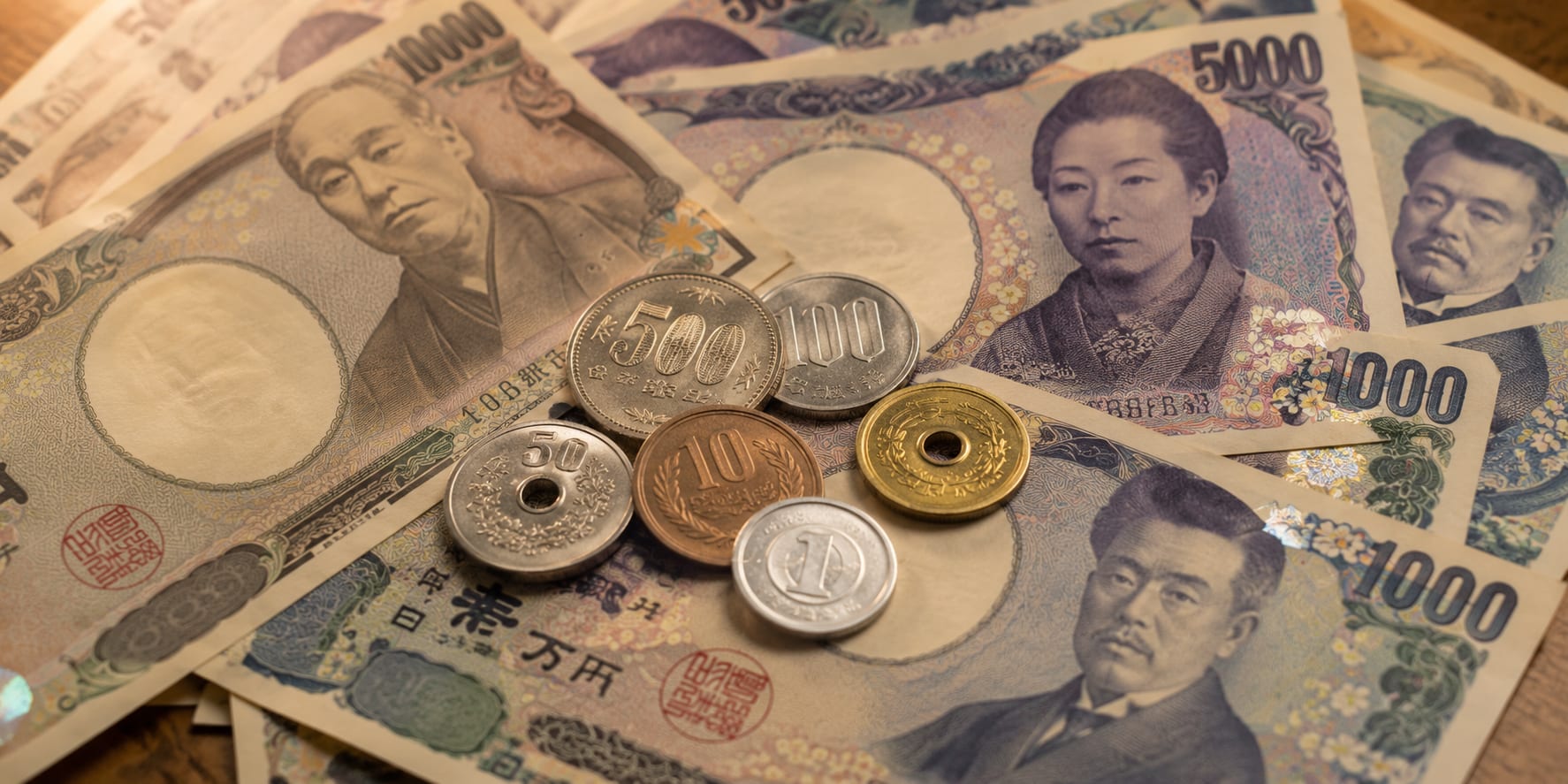
Money in Japan: The Complete Guide for Travelers
Japan is not a cash-only country, but cards are not accepted everywhere either. Here is exactly how to pay for things, from ATMs to IC cards to tipping.
Is Japan a Cash-Only Country?
Japan is not the cash-only country its reputation suggests, but it is not fully cashless either. Cards now cover hotels, department stores, and most chain restaurants, yet plenty of small restaurants, shrines, rural shops, and even some city businesses still take cash only. The practical answer for almost every traveler is to carry a mix: cash, a credit or debit card, and an IC card for transit and small daily purchases.
METI reports that cashless payments accounted for 58.0% of consumer spending value nationwide in 2025, but that is not a share of individual transactions or proof that every shop accepts cards. Cash is still useful at smaller businesses, shrines, and some rural locations.
Most of what confuses first-time visitors, an ATM that rejects a foreign card, a shop that turns out to be cash-only, an unfamiliar bill, has a simple fix once you know the pattern. In your first hour in Japan, exchange or withdraw a starting amount of cash, confirm your IC card is loaded or in hand (see our transportation guide for how), and note the four ATM networks below that reliably work with foreign cards for the rest of your trip.
Do I need cash or a card in Japan? Bring both. Withdraw yen from Seven Bank/7-Eleven, Japan Post Bank, Lawson Bank, or AEON Bank ATMs, and always decline the option to be charged in your home currency. See which payment mix fits your specific trip in Which Payment Strategy Fits Your Trip below.
See Which Payment Strategy Fits Your Trip →Cash vs. Card in Japan
Neither one alone gets you through a Japan trip
| Payment Method | Best For | Where It Falls Short |
|---|---|---|
| Cash | Small shops, shrines and temples, rural areas, vending machines without card readers | Nothing to fall back on if you run out between withdrawals |
| Credit / Debit Card | Hotels, department stores, chain restaurants, larger purchases | Many small, independent, and rural businesses do not take cards at all |
| IC Card (Suica/PASMO/ICOCA) | Convenience stores, vending machines, station kiosks, transit, small daily purchases | Needs periodic top-up, and acceptance thins out outside cities |
Bring all three. Use an IC card for transit and small daily purchases, a credit or debit card for larger, predictable spending at hotels and chain businesses, and cash as the fallback that works everywhere else, especially once you leave major cities.
ATMs and Withdrawing Cash in Japan
It is not that foreign cards don't work here, it's that most ATMs are the wrong network
The most common ATM complaint from travelers is not that Japan lacks foreign-card access, it's that they tried the wrong machine. Community travel-forum discussions consistently point to the same three or four networks as the ones that actually accept foreign-issued cards, while most other Japanese ATMs, including many at Japanese banks themselves, decline a foreign card outright.
| Network | Fee | Limit |
|---|---|---|
| Seven Bank / 7-Eleven | ¥0 to about ¥220 per withdrawal, varies by card network | Roughly ¥50,000-¥100,000 per transaction, varies by card |
| Japan Post Bank | Similar ¥0-¥220 range, varies by card network | Roughly ¥50,000-¥100,000 per transaction, varies by card |
| Lawson Bank | Similar ¥0-¥220 range, varies by card network | Roughly ¥50,000-¥100,000 per transaction, varies by card |
| AEON Bank | Similar ¥0-¥220 range, varies by card network | Roughly ¥50,000-¥100,000 per transaction, varies by card |
Fee and limit figures vary by source, by your specific card network, and by your own bank's foreign-withdrawal policy, and they change periodically. Treat them as a planning range, not a guarantee, and confirm your own card's fees with your bank before you travel.
Withdrawing with a Wise card? Its free ATM allowance depends on the country your card is issued in. See which ATMs we use and how Wise ATM fees work.
Always Decline Dynamic Currency Conversion (DCC)
If an ATM or card terminal asks whether you want to be charged in US dollars (or another home currency) instead of yen, always choose yen. This is dynamic currency conversion, and it applies a materially worse exchange rate, commonly cited as 3-8% above the interbank or mid-market rate, than simply letting your own bank or card network convert the charge.
Currency Exchange: Airport, City, or ATM?
You don't need to exchange a large amount before you land
Airport exchange counters are the most convenient option right after you clear customs, but withdrawing yen directly from one of the four ATM networks above is usually a simpler and more predictable way to get the bulk of your cash once you're in the country. City currency exchange counters and licensed money changers are a third option, though you need to locate one during its own business hours. The simplest approach for most travelers: exchange or withdraw a small amount for your first few hours in Japan, either before departure or at the arrival airport, then rely on the four confirmed ATM networks for the rest of your trip.
Japanese Bills and Coins
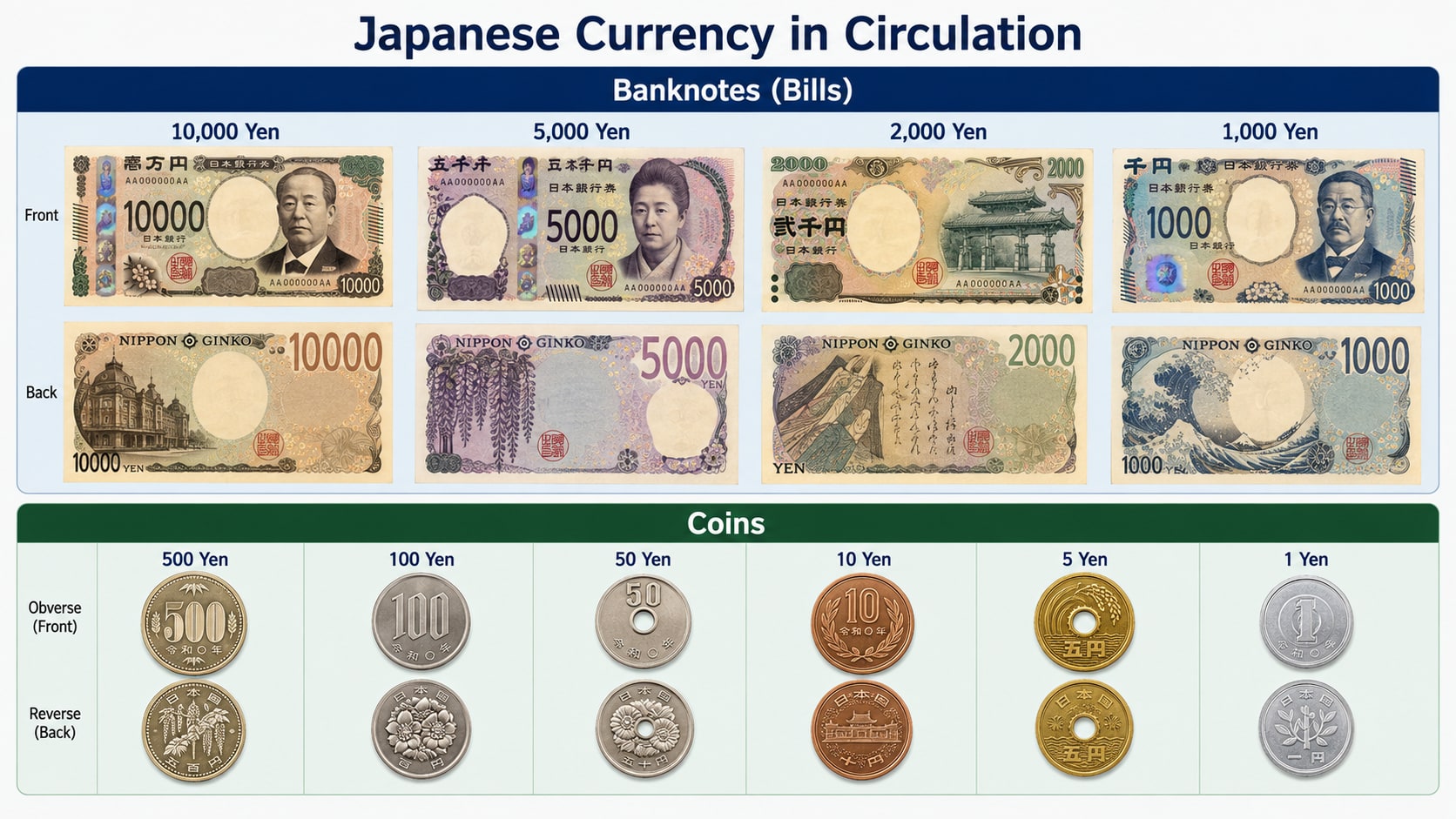
Six coins and four banknotes currently in circulation
| Denomination | Type | Status |
|---|---|---|
| ¥1 | Coin | In wide circulation |
| ¥5 | Coin | In wide circulation |
| ¥10 | Coin | In wide circulation |
| ¥50 | Coin | In wide circulation |
| ¥100 | Coin | In wide circulation |
| ¥500 | Coin | In wide circulation |
| ¥1,000 | Banknote | Redesigned July 2024; older design remains valid |
| ¥2,000 | Banknote | Valid, but genuinely rare outside Okinawa |
| ¥5,000 | Banknote | Redesigned July 2024; older design remains valid |
| ¥10,000 | Banknote | Redesigned July 2024; older design remains valid |
New ¥1,000, ¥5,000, and ¥10,000 notes entered circulation starting July 3, 2024, the first Japanese banknote redesign in about two decades, featuring Kitasato Shibasaburo, Tsuda Umeko, and Shibusawa Eiichi respectively, with upgraded anti-counterfeiting features including 3D holograms and enhanced tactile marks. Older-design notes remain fully valid, legal tender with no expiry or exchange deadline under Japanese law, so do not worry if a shop or ATM hands you a pre-2024 bill.
The ¥2,000 note is a special case. It remains technically valid, but production has been halted since fiscal year 2003 and it now makes up only a small fraction of banknotes in circulation nationwide, so most ATMs and vending machines do not dispense or accept it. You will encounter it more often in Okinawa, where it is more actively used and promoted by local businesses. Elsewhere in Japan, treat it as valid but essentially something you are unlikely to need to recognize.
Credit and Debit Cards in Japan
Acceptance has broadened, but it's still not universal, and which network you carry matters
| Network | Acceptance |
|---|---|
| Visa | Broadest acceptance |
| Mastercard | Broadest acceptance |
| JCB | Broad, unusually strong at small and independent shops |
| UnionPay | Broad acceptance |
| American Express | Narrower acceptance |
| Discover | Narrower acceptance |
Many standard credit and debit cards add a foreign transaction fee, typically a percentage of each purchase, on top of whatever exchange rate they apply. Before you go, find out what your own card charges. If it adds a fee, a low-fee travel card is worth comparing; if it does not, your card may already be a good way to pay in Japan. Whichever card you carry, always choose to be charged in yen at the terminal.
IC Cards as a Payment Method
Suica, PASMO, and ICOCA do far more than pay for trains
This section assumes you already have a Suica, PASMO, or ICOCA card, loaded on your phone or in physical form. For how to get an IC card, add it to your phone, or top it up, see our IC cards in Japan guide.
Beyond trains, subways, and buses, an IC card works as a tap-and-go payment method at a wide range of everyday purchases: convenience stores (7-Eleven, Lawson, FamilyMart), vending machines, station kiosks and shops, coin lockers, some restaurants and cafes, drugstores, supermarkets, and taxis. For small, fast purchases, it is usually quicker than pulling out cash or a card, since you simply tap and go.
Because it's prepaid, an IC card only works with a positive balance. Keep an eye on it and top it up before a heavy travel day rather than discovering it's empty at a crowded gate or checkout.
Spending most of your trip in the capital? Our Getting Around Tokyo guide has more Tokyo-specific detail.
Apple Wallet, Apple Pay, and Google Wallet
Apple Wallet is broadly reliable; Android support depends on your exact phone
Apple Wallet is a reliable way to carry a mobile IC card in Japan: Suica can be added directly in the Wallet app on a compatible iPhone or Apple Watch (JR East also offers the Welcome Suica Mobile app for visitors), and recharged using a credit or debit card already linked in Apple Pay, with no cash top-up machine required. PASMO's Apple Pay setup requires the device region to be set to Japan, so check the current conditions before you rely on it. For how to get an IC card, add it to your phone, or top it up, see our IC cards in Japan guide.
Google Wallet and Android support is genuinely more fragmented. Suica can now be added directly via Google Wallet on many, though not all, Android devices that have the necessary FeliCa/Osaifu-Keitai hardware and Android 9 or later; PASMO still requires its own separate dedicated app rather than working through Google Wallet directly. The catch is hardware, not software: most Android phones sold outside Japan lack the enabled FeliCa chip even after a full update, so most international travelers' own Android phone will not support a mobile IC card no matter what app they install. If you carry an Android phone, do not assume this will work; the reliable fallback is a physical Welcome Suica or Tourist PASMO card.
Apple Pay and Google Pay can also be used the same way you'd use a physical card, wherever contactless card payment is accepted, by adding your own foreign credit or debit card to the wallet app. This is separate from the IC card function and simply follows the same acceptance pattern as your underlying card network.
Any of this assumes a working phone with data. If you still need to sort out connectivity before you land, see our eSIM guide.
Payment Apps Like PayPay
Optional for most short-term tourists
PayPay and similar Japanese payment apps are popular with residents, but they are not essential for most short-term tourists; cash, cards, and IC cards already cover nearly every situation described on this page. Some sources report that a non-Japanese phone number is now enough to register for tourist use, with a cash top-up at a convenience-store ATM, a change from PayPay's historically Japanese-phone-number-only requirement, but this has not been confirmed clearly enough to treat as settled. If you want to try a Japanese payment app, treat it as an optional extra rather than something to set up before you go.
For the apps most travelers actually use, navigation, translation, taxis, and train tickets, see our full guide to Japan travel apps.
Tax-Free Shopping and Payment
A system change is coming mid-guide, so this page states both dates explicitly
Japan's tax-free shopping system is changing on November 1, 2026. This guide describes both the current system, in effect through October 31, 2026, and the new system that replaces it, so the information stays accurate whichever side of that date your trip falls on.
Current System: Through October 31, 2026
Through October 31, 2026, eligible purchases at tax-free-registered stores have the 10% consumption tax deducted directly at the point of sale after you show your passport at checkout. The current system, in effect through October 31, 2026, separates purchases into two categories, general goods and consumables, each with its own rules, and consumables must leave the store in tamper-evident sealed packaging that cannot be opened in Japan.
New System: Starting November 1, 2026
Starting November 1, 2026, the point-of-sale deduction is replaced by a refund model. From November 1, 2026, you pay the full tax-inclusive price at checkout, then apply for a refund of the consumption tax after Japan Customs confirms the goods are leaving the country, with the refund claim required within 90 days of purchase. The separate general-goods and consumables categories, along with the sealed-packaging requirement for consumables, are both eliminated starting November 1, 2026.
Which System Applies to Your Trip
If your trip falls before November 1, 2026, expect the current point-of-sale deduction described above. If your trip is on or after November 1, 2026, expect to pay full price at checkout and claim a refund after customs confirms your goods are leaving the country.
Source: National Tax Agency of Japan, official guidance on the departure tax-free refund method.
Tipping in Japan
Not customary, with one narrow exception
Tipping is not customary in Japan and can cause confusion rather than gratitude. Restaurant, taxi, and hotel bills already reflect the full price, and service is not tied to an expected gratuity the way it is in the US. Leaving cash on a table is more likely to prompt a server to chase you down to return it than to be accepted as a tip.
The one genuine exception is kokorozuke, a small gift of thanks sometimes given to ryokan staff for exceptional, personalized service during a stay, traditionally presented in an envelope and handed over discreetly, often at the start of the stay rather than at checkout. It is optional, not expected, and does not apply outside the ryokan context. For tipping and other etiquette expectations across the rest of your trip, see our cultural etiquette guide.
Money Safety in Japan
A real reputation for low theft risk, not a reason for carelessness
Japan's reputation for low theft risk is real, lost wallets are often turned in intact, but that is not a reason to be careless with cash. Keep the bulk of your cash split between a wallet and a separate bag or hotel safe rather than carrying it all in one place, especially in crowded tourist areas.
If you are carrying a large amount of cash into or out of Japan, note that amounts over ¥1,000,000 (or the equivalent in another currency) must be declared to Japanese customs; this applies to cash you bring with you, not routine ATM withdrawals or card spending during your trip.
If you lose your card or wallet: call your card issuer immediately to freeze or cancel the card, file a report at the local police box (koban) for any lost ID or residence-related item, and let your hotel know in case the item turns up. A lost card or wallet is also the kind of event travel insurance is built for; see our travel insurance guide for what's typically covered.
- •Notify your card issuer of your travel dates before you leave; most declines travelers hit in Japan are a fraud hold from their own bank, not a Japan-side problem
- •Seven Bank/7-Eleven, Japan Post Bank, Lawson Bank, and AEON Bank are the four ATM networks that reliably accept foreign cards; treat any other ATM as a maybe
- •Suica, PASMO, and ICOCA work as payment far beyond trains: convenience stores, vending machines, coin lockers, and many cafes and drugstores all accept a tap
- •Old, pre-2024 banknotes remain fully valid anywhere in Japan; there is no expiry or exchange deadline
- •Japan's tax-free shopping system changes on November 1, 2026; know which system, point-of-sale deduction or after-departure refund, applies to your own trip dates
- •Always decline dynamic currency conversion at an ATM or card terminal; choose to be charged in yen, never your home currency
- •Confirm your mobile wallet actually supports a Japanese IC card before you rely on it, especially on Android, or plan on a physical Welcome Suica or Tourist PASMO instead
- •Exchange or withdraw a small starting amount of cash for your first few hours in Japan, then rely on the four confirmed ATM networks for the rest of your trip
Common Payment Mistakes
Specific, avoidable errors travelers hit when paying for things in Japan
Accepting dynamic currency conversion at an ATM or card terminal
Instead: always choose to be charged in yen, never your home currency. DCC applies a materially worse exchange rate, commonly 3-8% above the interbank rate.
Assuming every convenience-store ATM accepts foreign cards
Instead: rely on the four confirmed networks, Seven Bank/7-Eleven, Japan Post Bank, Lawson Bank, and AEON Bank, not any ATM with a familiar logo.
Assuming a small shop, shrine, or rural business takes cards at all
Instead: carry enough cash as your default outside major chains and cities.
Letting an IC card balance run to zero right before a heavy travel day
Instead: top it up proactively before you need it, not reactively at a crowded gate. See our transportation guide for how.
Not notifying your card issuer before departure
Instead: call ahead to flag international travel. Most card declines travelers hit in Japan are a fraud hold from their own bank, not a Japan-side problem.
Overpacking cash out of anxiety
Instead: a working ATM network is usually nearby. Japan is not the cash-only country its reputation suggests.
Misunderstanding the November 2026 tax-free system change
Instead: know which system, current through October 31, 2026, or new starting November 1, 2026, applies to your own trip dates before you shop.
Which Payment Strategy Fits Your Trip
There is no single right mix of cash, card, and IC card, it depends on your trip shape
Budget Traveler
Lean on cash and your IC card for daily spending so you can track costs closely and skip card foreign-transaction fees on small purchases. Withdraw larger amounts less often from the four confirmed ATM networks to minimize per-withdrawal fees, and if your usual card adds a foreign transaction fee, a low-fee travel card such as Wise is worth comparing before you go.
Family Traveler
Keep a shared cash reserve for smaller purchases and split your spending across more than one card so a single decline does not strand the group. Make sure every adult in the party carries at least one working card and knows the backup plan if one goes offline.
Luxury Traveler
Cards are reliable at higher-end hotels, restaurants, and department stores, but still carry cash for ryokan kokorozuke, smaller boutique shops, and any rural detours, where card acceptance thins out fast.
Business Traveler
Rely on cards for predictable, expensable spending, and notify your card issuer before departure so a fraud hold doesn't strand you mid-trip. Keep cash on hand for smaller vendors and situations where speed matters more than a paper trail.
Solo Traveler
Lean on a mobile wallet, Apple Wallet is the most reliable option, for IC card top-ups and daily purchases, and keep a modest cash reserve as backup since you don't have a travel companion's card to fall back on if yours is declined.
Long-Term / Multi-City Traveler
Build a sustainable cash-flow rhythm instead of one large exchange: withdraw from the four confirmed ATM networks as you go rather than carrying a lump sum, and know more than one network by name in case your usual one is not available in a smaller city.
Common Money Questions
Other Planning Topics
Ready to See It Day by Day?
Browse itineraries already costed out for budget, mid-range, and luxury trips.
Browse Itineraries →