Hiroshima Peace Memorial Park

ExploreJapanDaily Editorial Team · Last verified: June 28, 2026

Quick Answer
Hours
Open 24 hours daily; museum 8:30 AM – 6:00 PM
Admission
Free (Peace Memorial Museum: 200 yen)
Nearest Station
Genbaku Dome-mae, 2 min walk
Best Time
Morning for quiet reflection
Visit Duration
2–4 hours including the museum
Hiroshima Peace Memorial Park with the A-Bomb Dome ruins and surrounding city viewed on a clear blue sky day, Japan

Visiting Hiroshima Peace Memorial Park

Hiroshima Peace Memorial Park is one of the most significant historical and cultural sites in Japan, a place where remembrance, reflection, and hope for peace exist side by side within the center of a modern city. Located near the point where the atomic bomb detonated over Hiroshima on August 6, 1945, the park was created not simply as a memorial space, but as a public commitment to remembering the human consequences of war. Today, visitors from around the world walk through its tree-lined paths, bridges, riverside walkways, museums, and monuments, experiencing an atmosphere that feels both deeply emotional and remarkably calm.

Before the Second World War, this area was one of Hiroshima's busiest commercial and residential districts, filled with shops, homes, offices, schools, and streetcars. The bombing destroyed nearly everything within the surrounding area in a matter of moments, transforming the center of the city into devastation. In the years that followed, Hiroshima made the deliberate decision to preserve this section of land as a memorial dedicated to peace rather than redeveloping it entirely for commercial use. The result is a park that functions simultaneously as a place of mourning, education, historical memory, and everyday public life.

The design of Hiroshima Peace Memorial Park reflects this balance carefully. Wide green spaces stretch between rivers and memorial structures, creating an atmosphere that feels open and contemplative rather than overwhelming. Architect Kenzo Tange, one of Japan's most influential modern architects, designed much of the park's layout after the war. His vision connected the memorial spaces visually and symbolically through long sightlines, bridges, and carefully placed monuments. Walking through the park today, visitors often notice how intentionally quiet the environment feels despite being surrounded by a functioning modern city.

A-Bomb Dome viewed from across the Motoyasu River with visitors walking along the riverbank, Hiroshima Japan

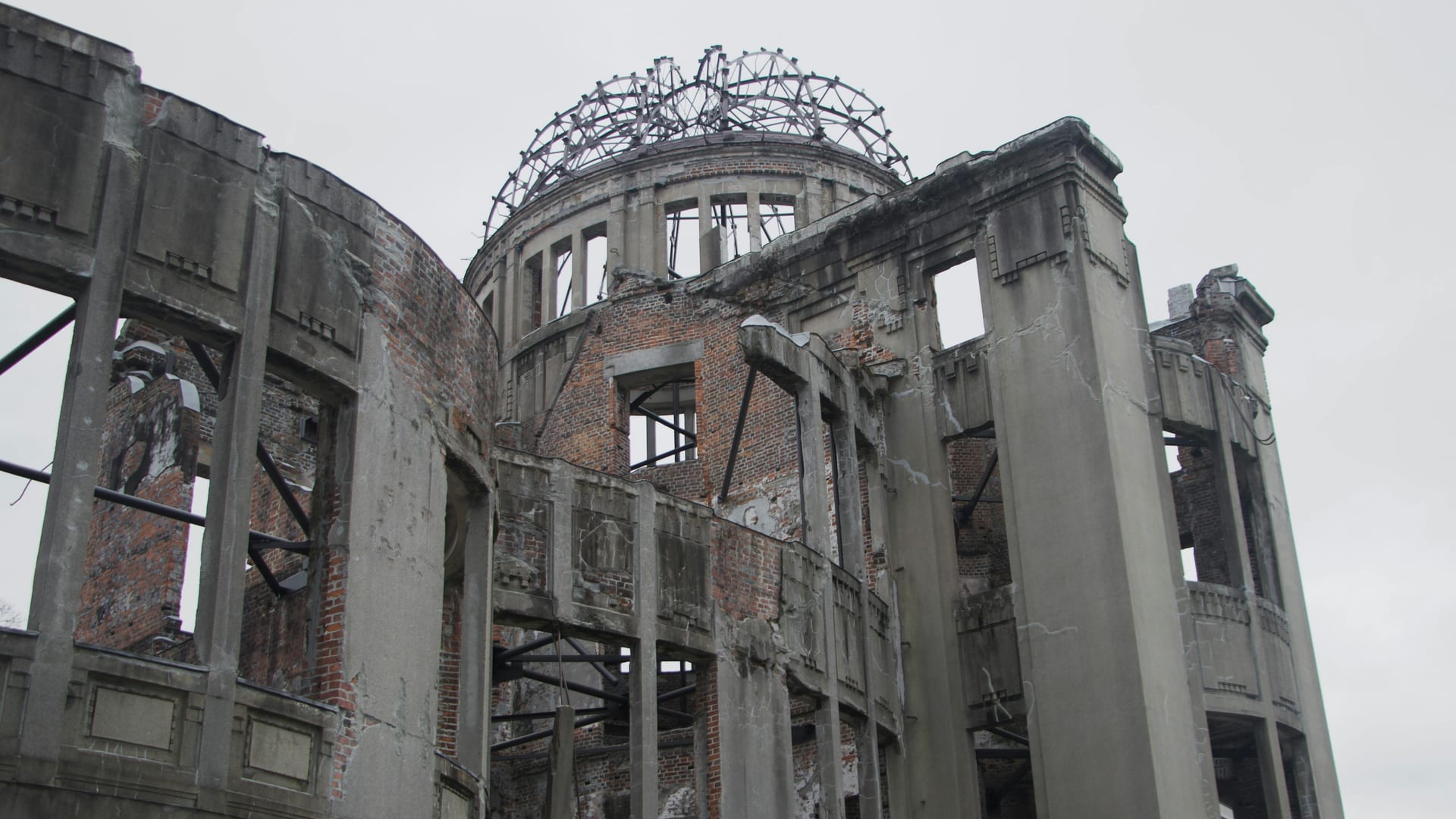
One of the most recognizable landmarks within the park is the Atomic Bomb Dome, the preserved ruins of the former Hiroshima Prefectural Industrial Promotion Hall. Standing across the Motoyasu River, the structure remains as a physical reminder of the destruction caused by the bombing. Yet the park itself extends far beyond a single monument. Memorials dedicated to children, victims, students, and unidentified lives lost throughout the bombing are spread throughout the grounds, each carrying its own emotional weight and historical meaning. The Children's Peace Monument, inspired by Sadako Sasaki and the tradition of folded paper cranes, is especially moving for many visitors and continues to receive colorful cranes sent from around the world.

The atmosphere inside Hiroshima Peace Memorial Park changes depending on the season and time of day. Early mornings often feel especially quiet, with soft light reflecting across the rivers while local residents jog or walk silently along the pathways. Spring brings cherry blossoms that frame sections of the park in pale pink, creating a visual contrast between beauty and historical sorrow that many travelers find deeply affecting. Summer carries additional emotional significance because the annual Peace Memorial Ceremony is held every August to mark the anniversary of the bombing. Autumn introduces calmer colors and cooler air, while winter often creates the most reflective atmosphere of all, with fewer crowds and long shadows stretching across the memorial grounds.

One of the reasons Hiroshima Peace Memorial Park leaves such a lasting impression is the way it exists within the daily rhythm of the city rather than apart from it. Office workers cross the park during lunch breaks, students gather near the riverside, and local residents continue to use the area as public space while also respecting its deeper meaning. This coexistence between remembrance and ordinary life gives the park an authenticity that is difficult to replicate. It does not feel staged or frozen in time. Instead, it remains fully integrated into modern Hiroshima while continuously reminding visitors of the city's past.

Hiroshima Peace Memorial cenotaph illuminated at night with reflecting pool and surrounding cherry trees, Japan

The surrounding cityscape reinforces this emotional contrast. Modern Hiroshima feels vibrant, organized, and welcoming, with shopping streets, cafés, restaurants, streetcars, and universities extending outward from the memorial district. Seeing the park against the backdrop of contemporary city life makes Hiroshima's reconstruction after the war feel even more tangible. The memorial spaces do not stand within ruins alone. They stand within a rebuilt city that consciously chose to preserve memory while continuing forward.

The Hiroshima Peace Memorial Museum, located within the park, adds historical context through personal belongings, photographs, testimonies, and detailed exhibits explaining the bombing and its aftermath. For many travelers, visiting the museum changes the emotional tone of the entire park afterward. Objects such as burned clothing, watches stopped at the moment of the blast, and handwritten survivor accounts create a human connection to events that can otherwise feel distant in history books. Yet despite the weight of the subject matter, the broader atmosphere of the park remains focused not only on tragedy, but also on peace advocacy and the hope of preventing future nuclear conflict.

For international travelers, Hiroshima Peace Memorial Park often becomes one of the most emotionally complex places visited during a trip to Japan. It is historically important on a global scale, but the experience itself feels deeply personal and human rather than abstract. The park encourages visitors to slow down, observe quietly, and reflect on the relationship between memory, loss, resilience, and reconciliation. There are few places in the world where historical significance, public space, architecture, and emotional atmosphere come together so powerfully.

A-Bomb Dome and Hiroshima cityscape viewed from across the river on a clear sunny day, Japan

Hiroshima Peace Memorial Park is not designed around spectacle or tourism in the traditional sense. Its purpose is quieter and more enduring. Through rivers, trees, monuments, open sky, and preserved spaces, the park continues to communicate a message that remains relevant far beyond Hiroshima itself. Visiting is less about checking off a landmark and more about experiencing a place where history remains visibly present within the everyday life of a modern city dedicated to peace.

Things to Do at Hiroshima Peace Memorial Park

How to Get to Hiroshima Peace Memorial Park

Hiroshima Peace Memorial Park is located in central Hiroshima and is easily accessible by tram, bus, taxi, and on foot from many major city attractions.

💡Good to Know
  • Nearest station: Genbaku-Domu-mae or Fukuro-machi tram stops (Hiroshima Electric Railway)
  • IC cards (Suica, Pasmo, or ICOCA) are accepted on trains, subways, and buses throughout Japan. Tap in and out at every gate.
  • Avoid traveling during rush hour on weekdays: 7am to 9am and 5pm to 8pm. Trains are significantly more crowded.
  • Google Maps provides accurate real-time transit directions in Hiroshima. Download offline maps before you arrive.

Map

Best Time to Visit Hiroshima Peace Memorial Park

Best time to visit Hiroshima Peace Memorial Park: Morning for quiet reflection; August 6 for the Peace Memorial Ceremony. Weekday mornings are generally quieter than weekends and public holidays.

💡Good to Know
  • Best time to visit: Morning for quiet reflection; August 6 for the Peace Memorial Ceremony
  • Arriving on a weekday morning avoids the largest crowds. Weekends and public holidays are significantly busier.
  • Spring (late March to early May) and autumn (October to November) are the most popular seasons for visiting Hiroshima.
  • Golden Week (late April to early May) is the busiest week of the year in Japan. Book accommodation and tickets well in advance.
Cherry Blossom (Spring)
Late March to early April

Cherry trees throughout the park bloom alongside the rivers, framing the Atomic Bomb Dome and memorial monuments in pink.

Peace Memorial Ceremony
August 6

The annual ceremony marking the anniversary of the atomic bombing draws large crowds and international attention to the park.

Autumn Foliage
Mid-November to early December

Trees along the riverside paths turn warm colors, creating a quieter, reflective atmosphere around the monuments.

Entry Fee & Hours

🎟️
Admission
Free (Peace Memorial Museum: 200 yen)
Hours
Park grounds open 24 hours daily; Peace Memorial Museum open 8:30 AM – 6:00 PM (extended to 7:00 PM in August, 7:30 PM during peak summer)
Peace Memorial Museum Admission
Peace Memorial Museum Admission admission prices in JPY and approximate USD
CategoryPrice (JPY)Approx. (USD)
Adult / General¥200~$1.3
Elementary, Junior High & High School StudentsFreeFree

The memorial park itself is free to enter. Prices below apply only to the Peace Memorial Museum inside the park.

💡Good to Know
  • The park's main pathways, bridges, and monument plazas are flat, paved, and wheelchair and stroller accessible throughout. The Peace Memorial Museum has elevators connecting all floors and accessible restrooms.
Book Tickets

Nearby Attractions

Combine with Hiroshima Peace Memorial Park on the same day

Atomic Bomb Dome preserved ruins with skeletal iron dome frame and brick walls against grey sky, Hiroshima Japan
Naka, Hiroshima

Atomic Bomb Dome

HistoryPhotography
Hiroshima's most iconic UNESCO World Heritage ruins beside the park.
A-Bomb Dome viewed from across the Motoyasu River with visitors walking along the riverbank, Hiroshima Japan
Naka, Hiroshima

Hiroshima Peace Memorial Museum

HistoryEducation
Powerful museum with survivor testimonies and atomic bombing exhibits.
Hiroshima Peace Memorial cenotaph illuminated at night with reflecting pool and surrounding cherry trees, Japan
Naka, Hiroshima

Orizuru Tower

ViewsPhotography
Modern observation tower with panoramic views over the memorial area.
A-Bomb Dome and Hiroshima cityscape viewed from across the river on a clear sunny day, Japan
Naka, Hiroshima

Hondori Shopping Street

ShoppingFood
Hiroshima's main covered arcade with restaurants, cafés, and souvenir shops.
Hiroshima Castle five-storey keep viewed from across the moat with autumn trees and blue sky, Japan
Naka, Hiroshima

Hiroshima Castle

HistoryPhotography
Reconstructed samurai castle with a history museum and scenic moat gardens.
📍Nearby
  • Atomic Bomb Dome (Adjacent, around 1-2 minutes walk): The preserved ruins of the former Hiroshima Prefectural Industrial Promotion Hall, the only structure near the atomic bomb hypocenter left standing. A UNESCO World Heritage Site and the most powerful symbol of peace in Hiroshima.
  • Hiroshima Peace Memorial Museum (Inside the park, around 3-5 minutes walk): Located inside the park grounds, this museum presents powerful historical exhibits, artifacts, photographs, and survivor testimonies related to the atomic bombing.
  • Orizuru Tower (Around 3-5 minutes walk): This modern observation tower beside Peace Memorial Park offers panoramic rooftop views over Hiroshima along with interactive exhibits and cafés.
  • Hondori Shopping Street (Around 7-9 minutes walk): Hiroshima's main covered shopping arcade filled with restaurants, souvenir shops, cafés, nightlife spots, and local shopping experiences within walking distance of the memorial area.
  • Hiroshima Castle (Around 15-20 minutes walk, or 5 minutes by tram): A reconstructed feudal castle originally built in 1589, housing a museum covering Hiroshima's samurai history. The castle grounds are especially beautiful during cherry blossom season.

Suggested Itinerary

Pair Hiroshima Peace Memorial Park with these nearby stops for a full day in Naka, Hiroshima.

MorningStart at Hiroshima Peace Memorial Park before crowds arrive (aim for opening time)
Late MorningHead to Atomic Bomb Dome (nearby, easy walk or short train)
AfternoonVisit Hiroshima Peace Memorial Museum
EveningReturn to your hotel or continue to another Hiroshima neighbourhood
See the full Off the Beaten Path: 14 Days Beyond the Golden Route itinerary →

Frequently Asked Questions

Hiroshima Peace Memorial Park with the A-Bomb Dome ruins and surrounding city viewed on a clear blue sky day, Japan
Plan Your Trip

Planning Your Hiroshima Trip?

See the full Hiroshima destination guide or browse Japan itineraries that include this city.

See all Museums across Japan →
➡️Suggested Next Guide

Explore all attractions in Hiroshima or browse nearby destinations.

Back to Hiroshima Guide →