Mt. Fuji 5th Station
ExploreJapanDaily Editorial Team · Last updated: October 9, 2026 · Facts verified: October 9, 2026
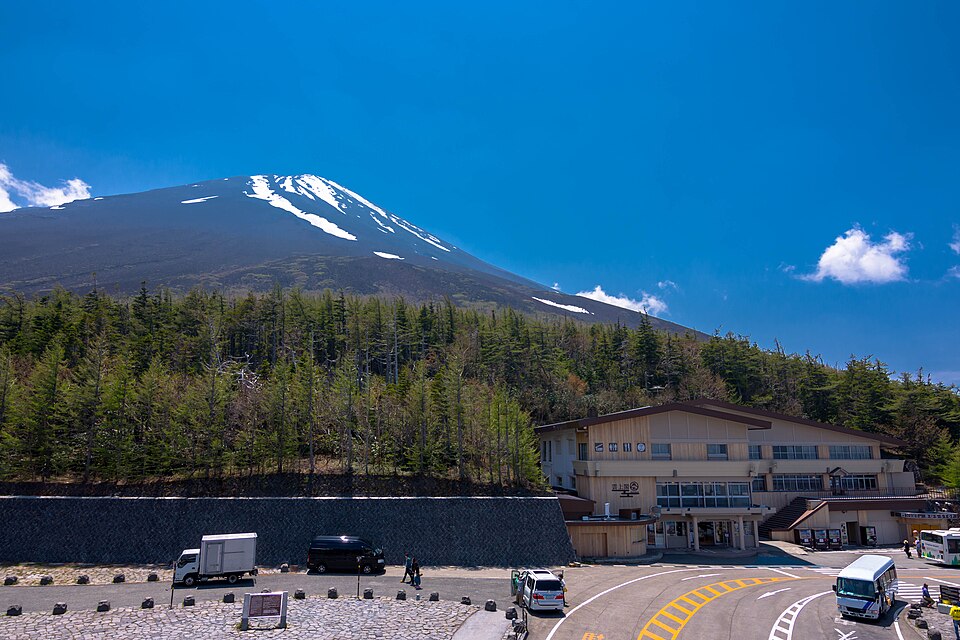
This guide covers the Fuji Subaru Line 5th Station (2,305 m), the trailhead of the Yoshida Trail on the Yamanashi side and the 5th Station that buses from Kawaguchiko and Shinjuku serve. It is one of four 5th Stations on Mount Fuji, each at the start of a different trail. You can visit without climbing and without paying the Hiking Fee, but only while the toll road is open to the top: snow closes the upper road in winter, and private cars are banned during the summer climbing season.
- Area
- Fujiyoshida
- Best For
- Mount Fuji up close, Non-climbers, Yoshida Trail trailhead, Mountain views
Which 5th Station, and when you can reach it
Mount Fuji has four climbing trails, and each begins at its own 5th Station: the Fuji Subaru Line 5th Station (Yoshida Trail, 2,305 m) in Yamanashi, and the Fujinomiya (2,400 m), Subashiri (2,000 m) and Gotemba New 5th Station (1,440 m) trailheads in Shizuoka. They are on different sides of the mountain, reached by different roads with different seasonal rules. Buses from Kawaguchiko Station, Fujisan Station and Busta Shinjuku go to the Fuji Subaru Line 5th Station covered here.
Access depends on the Fuji Subaru Line toll road, which does not close on a fixed winter date. In the 2025-26 winter it reached the 5th Station until 18 January 2026, then ran only as far as the lower parking areas below the 1st Station or at Osawa on the 4th Station because of snow, and it reopened to the 5th Station on 18 April 2026. Every winter is different, so check the road operator before a visit between December and April. Summer has the opposite problem: in 2026 private cars were barred from 3 July at 6:00 PM to 10 September at 6:00 PM, and drivers parked at Fujisan Parking near the Fujiyoshida Interchange and took a shuttle bus.
A sightseeing visit means an hour or two at 2,305 m: shops and restaurants, Komitake Shrine, views north toward the lakes on a clear day and, in the climbing season, free guided nature walks. A summit climb is a different trip. In the 2026 season it meant a 4,000 yen Hiking Fee, a reservation or on-site registration at the trail gate, and an official estimate of about 6 hours 10 minutes up and 3 hours 35 minutes down on the Yoshida Trail before breaks. Detailed climbing preparation is beyond this page; read the official Mt. Fuji climbing site before planning one.

At this altitude the air is thinner and much cooler than at the lakes, and the official climbing site warns that weather changes quickly on the mountain. Bring a warm layer even in summer, and take it slowly if you feel a headache or dizziness after the bus ride up.
What to do at the 5th Station without climbing
How to Get to Mt. Fuji 5th Station
The Fuji Subaru Line 5th Station is at the top of the Fuji Subaru Line toll road, which climbs from the Kawaguchiko and Fujiyoshida area.
- •Buses leave from Kawaguchiko Station and Fujisan Station, plus direct buses from Busta Shinjuku.
- •In winter, confirm the road reaches the 5th Station before setting out.
- •In the climbing season, drivers must use Fujisan Parking and the shuttle bus.
Map
Best Time to Visit Mt. Fuji 5th Station
Best time to visit Mt. Fuji 5th Station: Whenever the Fuji Subaru Line is open to the 5th Station, on a clear morning; climbers need the official season (1 July to 10 September on the Yoshida Trail in 2026). Weekday mornings are generally quieter than weekends and public holidays.
- •Morning gives the best chance of clear views; cloud often builds around the mountain later in the day.
- •July to early September is the busiest period, with climbers and the private-car ban.
- •Outside summer, check that the road is open to the top before you go; closures depend on snow, not a set date.
The Yoshida Trail was open, with the Hiking Fee, night entry rule and daily cap in force. Next season's dates are announced before it starts.
Drivers parked at Fujisan Parking and took the paid shuttle bus or a taxi.
Snow limited the road to the lower parking areas. Closure and reopening dates change every winter.
Entry Fee & Hours
- •Visiting the 5th Station is free. The Hiking Fee is charged only to climbers entering the trail.
- •Yoshida Trail, 2026 season: a 4,000 yen Hiking Fee per person; no entry from 2:00 PM to 3:00 AM except for mountain hut guests; a cap of 4,000 climbers a day; booking through Yamanashi Prefecture's Yoshida Trail reservation system or payment on site. These rules are set each year, so treat them as last season's until the next announcement.
- •The Shizuoka trails (Fujinomiya, Subashiri and Gotemba) charged the same 4,000 yen in 2026 and had the same night entry rule, but used registration and mandatory e-learning in the Shizuoka Prefecture FUJI NAVI app.
- •The 1,000 yen Mt. Fuji conservation contribution is voluntary and separate from the Hiking Fee.
Nearby Attractions
Combine with Mt. Fuji 5th Station on the same day

Lake Kawaguchiko

Chureito Pagoda

Oshino Hakkai

Fuji-Q Highland

Lake Yamanakako
- •Lake Kawaguchiko (By Fujikyu bus down the Fuji Subaru Line): The Fuji Five Lakes base most visitors use, with free shoreline views of Mount Fuji, a sightseeing cruise and easy train and bus links to Tokyo.
- •Chureito Pagoda (Bus to Fujisan Station, then two stops by train): A five-story memorial pagoda on the hillside above Fujiyoshida, 398 steps up, framed against Mount Fuji from its viewing deck.
- •Oshino Hakkai (Bus to Fujisan Station, then about 15 minutes by bus): Eight spring-fed ponds in Oshino village, fed by Mount Fuji's underground water, with thatched buildings and views of the mountain on clear days.
- •Fuji-Q Highland (Bus down to Kawaguchiko Station when the road is open, then one stop by train): A free-entry roller coaster park at the foot of Mount Fuji, with record-setting coasters, Thomas Land for small children and a variable-price One-Day Pass.
- •Lake Yamanakako (Bus down to Fujisan Station, then about 20 minutes by bus): The largest of the Fuji Five Lakes by area, on Mount Fuji's northeast side, known for Diamond Fuji sunsets in autumn and winter.
A half day up the mountain
The 5th Station is a half-day trip from Kawaguchiko by bus, best done in the morning.
Morning on the mountain, afternoon at the lake
Morning
Early Fujikyu bus from Kawaguchiko Station up the Fuji Subaru Line
Late morning
Komitake Shrine, the view and, in the climbing season, a guided nature walk
Afternoon
Bus back down to Lake Kawaguchiko and on to Oishi Park
Frequently Asked Questions
References
View references
Council for the Promotion of Appropriate Use of Mt. Fuji
Planning Your Mount Fuji Trip?
See the full Mount Fuji destination guide or browse Japan itineraries that include this city.
See all Nature & Scenic Spots across Japan →Explore all attractions in Mount Fuji or browse nearby destinations.
Back to Mount Fuji Guide →