Accessible Travel in Japan
A practical, honest planning guide for travelers who use wheelchairs or have limited mobility, covering what to expect, what to plan ahead of time, and where real barriers remain.
Is Japan Accessible for Travelers?
Japan is not uniformly accessible, and it is worth saying plainly: this is not a country where every station, hotel, and historic site offers step-free access. What is true is that accessibility has improved substantially in major cities over the last two decades, and a wheelchair user or someone with a mobility-limiting condition can travel through Tokyo, Osaka, and much of Kyoto with reasonable confidence. That confidence drops considerably once you move to rural stations, older private rail lines, and traditional temples and gardens, many of which were built long before step-free access was a design consideration. Good planning closes most, but not all, of that gap, and the sections below walk through exactly where to focus that planning.
Is Japan wheelchair accessible? Major cities and JR stations are increasingly well equipped, but accessibility varies sharply by city, station, and attraction. Rural lines and historic sites often still have real physical barriers, so planning ahead makes a substantial difference to how smoothly a trip goes.
See the Full Transportation Guide →Understanding Accessibility in Japan
Accessibility infrastructure in Japan has expanded steadily, with elevator installations, step-free routes, and universal toilets added to stations and public buildings on an ongoing basis rather than as a one-time push. Newer construction, including recent stations, shopping complexes, and hotels, is generally built with step-free access as a baseline expectation, not an add-on.
The gap that remains is mostly a gap between cities and everywhere else. Major metropolitan areas, especially Tokyo, Osaka, and Yokohama, benefit from newer transit networks and continuous investment. Rural regions and small towns, along with historic districts inside otherwise modern cities, move more slowly, since retrofitting a centuries-old temple or a narrow rural station is a fundamentally different problem than building a new subway line with accessibility designed in from the start.
Japan also has a strong culture of staff-provided assistance: station staff who bring a boarding ramp to the platform, hotel staff who help with luggage and room logistics, and airport staff who guide travelers through security and to the gate. This culture of assistance meaningfully offsets some physical infrastructure gaps, but it depends on requesting help, ideally in advance, rather than expecting every barrier to be automatically designed away.
Planning Before You Travel
Eight things worth settling before departure, not after you land
Flights
Book with an airline that lets you request wheelchair assistance and confirm seating needs at booking, not at check-in.
Flights Guide →Accommodation
Reserve accessible rooms early and confirm door width, shower type, and bed height directly with the property.
Accommodation Guide →Transportation
Map your key routes for elevator access and step-free exits before you book a multi-transfer itinerary.
Transportation Guide →Medical needs
Note the nearest major hospitals along your route if you manage an ongoing condition, and carry a written summary of any relevant history. This is general planning guidance, not medical advice, so confirm specifics with your own doctor before you travel.
Getting Sick in Japan Guide →Mobility equipment
Some hotels can arrange a rental wheelchair or scooter directly, and dedicated rental companies in major cities can deliver equipment to your hotel or the airport. If you travel with your own equipment, pack basic spare parts, since specialized parts are not always easy to source quickly outside major cities. Arrange rental or backup equipment during your initial packing planning rather than as an afterthought.
Travel insurance
Confirm your policy explicitly covers pre-existing conditions and mobility equipment, since standard policies do not always include this by default.
Insurance Guide →Emergency contacts
Save local emergency numbers, your embassy's contact details, and your accommodation's address written in Japanese, useful for taxi drivers or if you need help communicating your location.
Accessible attraction reservations
Some popular sites require advance reservations for accessible entry or equipment loans, so check each attraction's own site ahead rather than assuming walk-up access.
Airport Accessibility
Japan's three major international gateways offer comparable support
Narita International Airport
Wheelchair assistance, accessible restrooms, and elevators are available throughout the terminals, with step-free routes between check-in, security, and the gate.
Haneda Airport
Haneda's terminals are compact and well signed, with accessible restrooms and elevators at regular intervals and generally short distances between connections.
Kansai International Airport
Kansai offers the same core support as Narita and Haneda, with accessible transportation connections into Osaka and Kyoto via the airport limousine bus and rail links.
The most reliable way to use airport support is to arrange it with your airline in advance, ideally at booking or at least 48 hours before departure, rather than requesting it on arrival. If your trip includes a domestic connection, for example flying into Tokyo and out through a regional airport near Sapporo, confirm assistance separately for each leg and each airline, since arrangements do not always carry over automatically between connecting flights.
Transportation
Shinkansen, local trains, subways, buses, and taxis each have a different accessibility profile
JR lines are generally well set up
Major JR lines and stations in large cities typically have step-free routes, staff on hand, and boarding ramps. Rural JR branch lines are less consistent.
Private and local lines vary more
Smaller private railways, especially older lines in Kyoto and other historic cities, are more likely to have stairs-only stations or narrow platforms with no elevator.
Station staff will meet you at the platform
Requesting assistance in advance, in person at the ticket gate or by phone, gets you a staff member who brings a ramp to bridge the gap between the platform and the train and helps at your transfer and exit stations.
Advance notice helps most on longer routes
For a single local hop, walking up to the gate usually works. For multi-transfer trips or Shinkansen travel, arranging assistance the day before, or earlier, gives staff time to coordinate between stations.
Shinkansen wheelchair spaces are reservable
Reserved wheelchair spaces exist on Shinkansen trains and can be booked at a ticket counter, ideally a day or more ahead during busy travel periods when the limited spaces fill first.
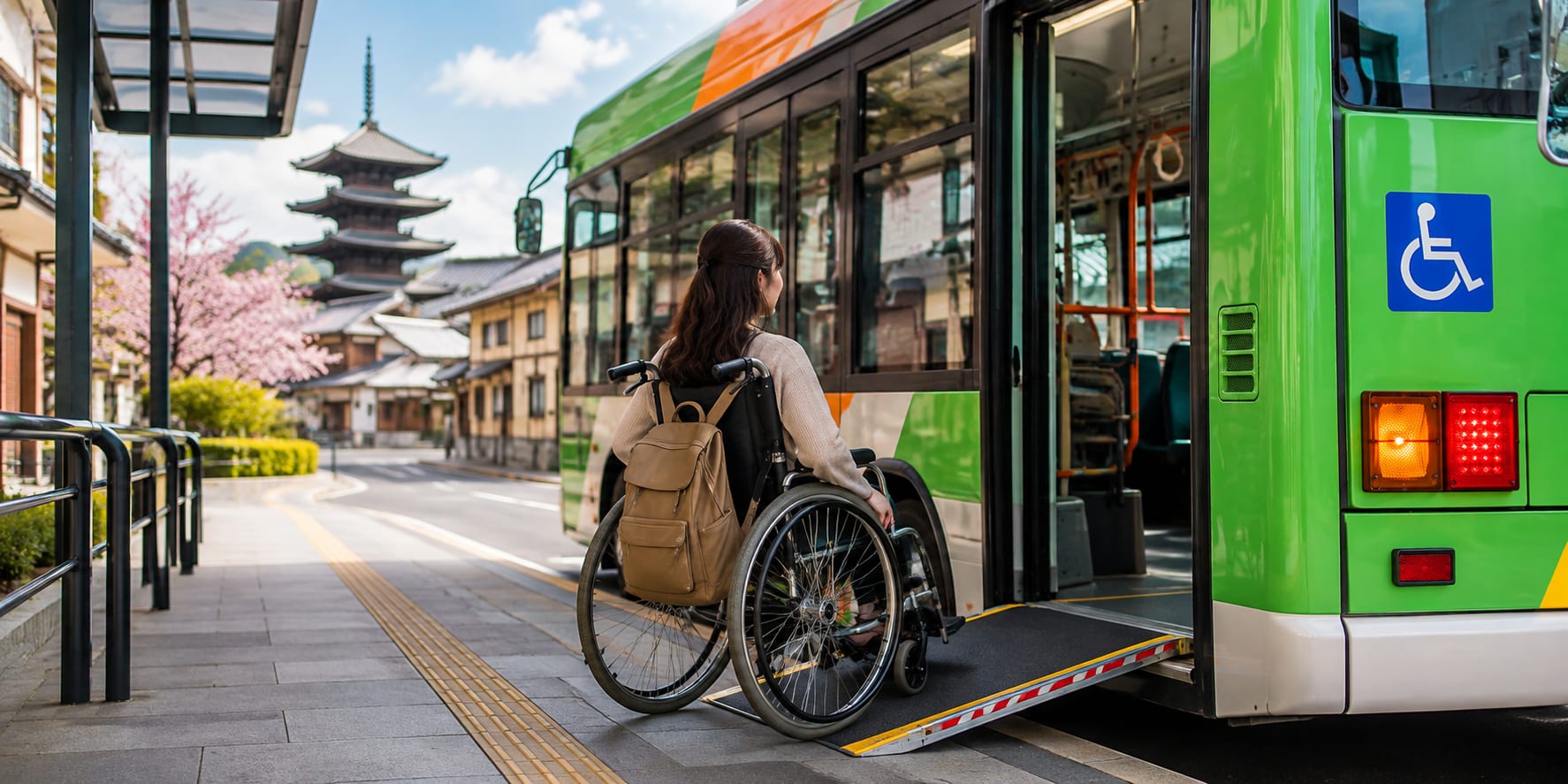
City buses in major metro areas increasingly use low-floor vehicles with a fold-out ramp, though rural bus service is far less consistent. Priority seating is standard on trains, subways, and buses, and the gap between a platform and a train (a real physical gap on many lines) is why station staff bring a boarding ramp rather than expecting a level boarding at every stop. Wheelchair-accessible taxis exist in major cities and are best requested by phone or through a hotel concierge rather than hailed on the street.
Accommodation
Larger international hotel chains and newer Japanese business hotels generally offer at least one or two accessible rooms, with wider doorways, roll-in showers or grab bars, and lower beds. Older ryokan and small family-run guesthouses, by contrast, often cannot accommodate a wheelchair at all, since many were built with tatami floors, raised thresholds, and narrow stairways that predate any accessibility standard. Elevators are standard in mid-size and large hotels but far from guaranteed in smaller, older properties, including some ryokan with only two or three floors.
- •Book accessible rooms as far ahead as possible; large hotels often have only one or two
- •Confirm specifics directly with the hotel, including door width, shower type, and bed height, rather than assuming "accessible" means the same thing everywhere
- •If a ryokan stay matters to your itinerary, ask specifically about step-free access and elevator availability before booking rather than after arrival
Visiting Attractions
Modern museums, observation decks, and theme parks like Tokyo Disneyland, Tokyo DisneySea, and Universal Studios Japan are generally well equipped, with step-free routes, wheelchair rental, and accessible ride entrances built into their design. Many historic temples, shrines, gardens, and original castle keeps are a different story: stone steps, gravel courtyards, narrow gates, and steep wooden stairways are common, and in many cases there is genuinely no step-free route, not because of poor planning but because these sites predate modern accessibility standards by centuries.
| Attraction Type | Examples | What to Expect |
|---|---|---|
| Modern museums, towers, and observation decks | teamLab venues, Tokyo Skytree, Tokyo Tower | Generally step-free, with elevators and accessible restrooms |
| Theme parks | Tokyo Disneyland, Tokyo DisneySea, Universal Studios Japan | Well equipped, with wheelchair rental and accessible ride entrances |
| Large historic temple complexes | Todai-ji in Nara | Spacious flat approach, though older halls may still have raised thresholds |
| Hillside and mountain shrines | Fushimi Inari Taisha in Kyoto | Gravel and stone paths with no step-free route beyond the lower gates |
| Traditional gardens | Many Kyoto and Tokyo strolling gardens | Gravel paths and small stepped bridges are common and rarely avoidable |
| Castles and steep hillside approaches | Himeji Castle's keep, Kiyomizu-dera in Kyoto | Original castle keeps are almost always stairs-only inside; approaches to hillside sites often involve stairs with no full step-free alternative |
At Mount Fuji, the 5th Station is reachable by accessible bus, but the hiking trails above it are not wheelchair accessible at any point. Checking a specific attraction's own accessibility page before you go, rather than assuming based on its category, is the most reliable way to avoid a surprise on-site.
Accessible Destinations
A high-level starting point; no city in Japan is uniformly accessible across every neighborhood
Tokyo
The most consistently accessible base, with newer subway lines, wide sidewalks in central wards, and well-equipped department stores.
Kyoto
A modern, accessible station and subway network, but far more inconsistency once you reach older streets and hillside temple districts.
Osaka
Broadly similar to Tokyo, with accessible subway lines and major shopping districts built around step-free access.
Hiroshima
The Peace Memorial Park is flat and largely step-free, and the city center is walkable with a modern tram network.
Hakone
Mixes accessible ropeway cars and boats with mountainous terrain that limits step-free options overall, so plan a slower pace.
Nara
Todai-ji has a spacious approach, though the surrounding park has uneven, deer-trodden paths worth knowing about in advance.
Yokohama
A newer waterfront city with wide, flat promenades and modern shopping and museum complexes that are generally easy to navigate.
Eating Out
Larger restaurants, hotel dining rooms, and department store restaurant floors are generally spacious and step-free, often with an elevator directly to the dining floor. Smaller, older restaurants, especially traditional izakaya and ramen shops, are more likely to have narrow entrances, a step at the door, or counter-only seating with no table option, so what looks like a small logistical detail can determine whether a specific restaurant works for your needs.
Calling ahead or booking through your hotel concierge is the most reliable way to confirm seating type and entrance access before you arrive. For dietary needs, a translated allergy or dietary card, prepared before your trip, communicates specifics more reliably than an in-the-moment conversation, particularly at smaller restaurants where English menus are less common.
Public Facilities
Multi-purpose "universal toilets," sometimes labeled dare-demo toilet, are widely available at major train stations, department stores, and many convenience stores across Japan. These are larger stalls with grab bars, more turning space, and often baby-changing and ostomy facilities in the same room, rather than a narrow accessible stall bolted onto a standard restroom.
Department stores and shopping centers are consistently among the most reliable accessible public spaces in any given neighborhood, with elevators, wide aisles, and accessible restrooms as standard. Train stations follow closely behind in major cities. Coverage thins out at rural highway rest areas (michi-no-eki) and smaller local facilities, so identifying the nearest reliable option, usually the closest major station or a large convenience store chain, is worth doing when routing through less central areas.
Communication
English ability among station staff, hotel staff, and restaurant staff varies considerably outside major tourist areas. Translation apps with camera and voice input handle most day-to-day requests well, and a few simple phrases prepared in advance make short interactions, like asking where the elevator is, noticeably smoother.
A few useful phrases
Japan uses the international wheelchair accessibility symbol at accessible entrances, elevators, and toilets nationwide, so the symbol itself is a reliable visual cue even without a shared language.
Common Accessibility Challenges
Named plainly, so you can plan around them rather than be surprised by them
Older and rural sidewalks
Away from major city centers, sidewalks are often narrower, uneven, or missing entirely, forcing a shared lane with car and bicycle traffic.
Stairs-only rural stations
Many small stations, particularly on rural and local lines, still have no elevator and only staircases between the platform and the street.
Gravel and stepped temple grounds
A genuine physical barrier exists at many historic temples and shrines: stone steps, gravel courtyards, and narrow gates that predate modern accessibility standards and are unlikely to change.
Language barriers when requesting help
English ability among station and hotel staff varies. Simple written requests, translation apps, or a printed phrase card make it easier to communicate specific needs clearly.
Rush-hour elevator queues and crowded trains
Elevators at busy stations can have long waits during morning and evening rush hours, and trains themselves get tightly packed, both worth avoiding when your schedule allows it.
Limited accessible hotel rooms
Even large hotels often hold only one or two accessible rooms, so they can sell out well before a trip, especially during cherry blossom or autumn foliage season.
Rural transportation gaps
Outside major cities, buses and taxis are less consistently equipped for wheelchair users, and service frequency drops, so rural legs of a trip need more buffer time and advance planning.
Common Planning Mistakes
Avoidable missteps that cost time or comfort partway through a trip
Booking without confirming accessibility
A listing marked "accessible" can mean very different things between properties. Confirm door width, shower type, and bed height directly before you book, not after check-in.
Changing hotels every night
A fast-moving itinerary multiplies the number of times you need to research and confirm accessibility from scratch. Fewer, longer stays reduce that repeated planning load.
Ignoring travel times between stops
Assistance requests, elevator waits, and longer routes around stairs all add time that a standard itinerary doesn't budget for. Build in slack rather than back-to-back stops.
Choosing historic accommodation without checking facilities
A traditional ryokan can be a highlight of a trip, but many were built with tatami floors, raised thresholds, and narrow stairways. Ask specifically about step-free access before booking, not as an afterthought.
Not requesting airport assistance in advance
Arranging wheelchair assistance with your airline at booking, or at least 48 hours ahead, is far more reliable than requesting it on arrival at the airport.
Essential Planning Guides
The rest of your trip planning, covered in dedicated guides
First Trip Guide
The essentials for a first visit to Japan.
Transportation Guide
Trains, subways, buses, taxis, and IC cards.
Money Guide
Cash, cards, ATMs, and IC cards in one place.
Packing Guide
What to bring for every season and travel style.
Insurance Guide
Coverage gaps to check before you buy a policy.
Visa Guide
Entry requirements for international travelers.
Best Time to Visit
Which season and month fits your trip.
Family Travel Guide
Planning advice for traveling with kids.
Final Planning Checklist
Before you depart
- Accommodation confirmed, with accessibility features verified directly with the property
- Airport assistance requested with your airline for every flight leg
- Travel insurance purchased, covering pre-existing conditions and mobility equipment
- Medication packed in original packaging, with a copy of your prescription
- Mobility equipment arranged, whether your own with spare parts or a confirmed rental
- Key transportation routes researched for elevator access and step-free exits
- Emergency contacts saved, including your embassy and your accommodation's address in Japanese
- Important documents copied, both physical and digital, including insurance and prescriptions
- •Major JR stations and central Tokyo and Osaka are the most consistently accessible parts of Japan
- •Universal toilets with grab bars and extra space are common at major stations, department stores, and convenience stores
- •Many historic temples, shrines, and gardens have real physical barriers, such as stone steps and gravel paths, with no step-free alternative
- •Accessible hotel rooms are limited in number even at large properties, so book them as early as possible
Building the rest of your route? Compare trains, IC cards, and route-planning tools before you lock in your itinerary.
Getting Around Japan →Accessible Travel in Japan Questions
Ready to Build a Route That Fits You?
Browse itineraries and adjust the pace to match the access needs of your trip.
Browse Itineraries →